
What is it with men and their fascination with their bodily noises?
I’ve been around men all my life…father, brothers, uncles, boyfriends, lovers, husbands…my life has been filled with them. And, to a greater or lesser degree, just about every one of them has found everlasting amusement in the sounds they can produce with their bodies sans vocal cords.
One of my brothers could burp the alphabet and talk with his burps…a useful skill should his larynx ever be removed, but a bit of a gross-out otherwise. This same brother, as a primary schooler, used to sprawl out in front of the TV on his belly and, engrossed in some mindlessly violent midday program, rip such loud explosions from his nether regions that my grandmother, usually the very picture of gentility and decorum, would occasionally remark “Goodness, did you scorch your shorts with that one?” Lacking in subtlety (or the ability to recognize it), my brother would simply laugh and attempt to muster up the necessary abdominal air pressure to do it again.
While one could argue this propensity is forgivable considering his tender age, it is important to note that there were three girl cousins of about the same age and the cousins and I were not prone to such displays. In fact, if a bodily sound escaped us from any place other than our vocal cords, we were overcome with mortification! Our brothers, on the other hand, would bask in manly pride.
Lest we try to forgive the little rascal with references to his tender age (and presumed lack of maturity), let us not forget that, as an adult, he has been known to do the “pull my finger” trick on younger family members. I haven’t asked his wife if he scorches his shorts these days, but there have been moments of temptation. Interestingly, the men in my life who find burping the Star Spangled Banner a worthwhile goal or whose rump-trumpeting skills are Guinness Book worthy, didn’t advertise their talents early in our relationships, proving to me that these are not uncontrollable events of nature, like a tsunami or Hurricane Katrina. If, on our first dates, they could sit through an entire evening of dinner, movie, and coffee without a single noticeable bodily emission, why must a televised football game, six months later, require the windows open to waft away noxious fumes?
This is not to say that women do not suffer from conditions requiring the release of steam…all people do and that’s just part of the human condition. The difference is that on average, women go about exercising their vents quietly and, if a sound emerges in the process it is invariably accidental…and the cause for a very immediate and horrified apology. Males of the species, on the other hand, tend to preen and the louder and longer the blast, the more polished the pride.
I haven’t figured out when guys think it is OK to rip a good one and when it is not. I have sat in many a board room and more engineering department meetings than I care to count, and nary a peep, so it isn’t the fact of males gathering together. My female presence surely did not put them off, as we women are well acquainted with the behavior, having endured it in our presence on numerous occasions… “ladies present” is not a mitigating factor. It seems to serve no other purpose than amusement, but it seldom amuses women…just the guy who does it and/or his buddies.
I don’t get it.
Thursday, February 09, 2006
The Sound and the Fury

Wednesday, February 01, 2006
Non-sequitur
On the topic of eschewing capital punishment because of its inherent fallibility, I have repeatedly received missives of the following nature:
What, in your opinion, happened to the right to life of a murder victim.
1. You have murderer a who may not be executed because the constitution protects his/her right to life.
2. You have a murder victim who HAD a right to life but it has been voided by the murderer whose right to life is still protected by the constitution.
Does the constitution only protect the right to life of murderers?
Something does not add up here.
The questions posed by this individual are non-sequiturs. The topic of the blog was the inherently fallible nature of capital punishment. It has nothing to do with the right to life of anyone other than a person incorrectly convicted of a capital crime and sentenced to death…a person who is not a murderer, but who may well be executed as one. The blog was about innocent people facing execution because the justice system has no way of ensuring 100% accuracy in its convictions and, because of that, it cannot justly condemn anyone to death without risking the execution of innocent people.
The American Constitution does not protect the lives of murderers…it permits the death penalty to exist, which, unfortunately takes the lives of the innocent as well as the guilty. The problem with the death penalty is that we humans cannot know if a person is truly guilty or not when we sentence him to death…we can only make our “best guess” based on the evidence presented to us and, entirely too often, we guess wrong. Would anyone reading this care to be shut alone in a windowless room less than six metres square for years on end, wondering each morning if this to be your last, when you committed no crime? If it happened to a law abiding citizen like Ray Krone, who wasn’t even in the wrong place at the wrong time but simply had crooked teeth, you can be assured that under such a justice system, you are just as much at risk as he was.
The question of one’s right to life covers the innocently convicted as much as it covers the victim of murder, and until there is a 100% accurate means of convicting only the murderer, until there is a 100% means of preventing convictions like Ray Krone’s, the mechanism by which Ray Krone was almost deprived of his life by the very government tasked to protect him must be dismantled. A man serving a sentence of life in prison without possibility of parole is as isolated from preying on society as a dead man: if he is guilty, he is punished by his isolation and the society is protected from his predations; but if he is innocent, if and when that fact finally comes out, he can be released. You can’t give an innocent…but executed…man the rest of his life back. It is important to err on the side of conservatism in matters of life and death…if you must make mistakes in conviction, which is inevitable at this point in history and scientific development, then those errors must not take innocent lives.
The life and death of the victim are moot in this discussion. The victim is already dead, his right to life violated, and no rights exist for dead people. At best, his remaining right is to have his killer apprehended and punished, but that is violated by the State when an innocent person is brought to book. But what of the rights of the person who committed no crime but who faces the death penalty anyway? What of his rights? What is germane here is the life of the innocent person who may be convicted for causing the victim’s death…because he is innocent, does he not have a right to have his life preserved? And what of the further victims of the real perpetrator, still running loose in society because the authorities, satisfied with their conviction of the innocent, fail to pursue? The real rapist/killer, in Ray Krone’s case, went on to sexually assault a child. Sentencing an innocent man to death deals a double tragedy, for not only can an innocent person face institutional death, the authorities cease to search for the real perpetrator, who continues to prey on society and may well commit further crimes.
The death penalty surely kills people guilty of murder. But it just as surely kills people innocent of it. And until we have an absolutely foolproof means of telling them apart, it simply makes sense to stop the killing. How, after all, does the execution of an innocent man effect justice for the victim?
A final note: many people mistakenly believe that the US Constitution guarantees its citizens “life, liberty, and the pursuit of happiness.” These words do not appear in the Constitution or in any of its Amendments. The words come from the Declaration of Independence, which does not have the force of law.
Monday, January 30, 2006
A Reasoned Response...
To my 29 January blog I received a comment that begs for response. Herewith my rejoinder:
All good and well, I agree, lets find a way to prevent wrongful sentencing. Sentence them to death only after being 100% sure. That, of course, is the crux of the entire matter: these individuals have been unanimously sentenced to death by twelve people…not one or two or even three, but twelve people…who were 100% sure of their guilt.
In these cases juries are not to be trusted. You’ll have to re-write the US Constitution to take juries out of the equation. It guarantees that people will be tried by a jury of their peers (meaning regular people, not members of the aristocracy). And since it is a part of the Bill of Rights, it is highly unlikely that such a change will ever be made…that document is considered more sacrosanct than the Constitution itself. In other words, it ain’t ever gonna happen, so juries and their inherent vagaries must be taken into account.
You need to have a panel of trained experts. What guarantees are there that these experts are infallible and incorruptible? If they aren’t, they’re no better than a jury.
The technology available today including DNA and more should allow there to be no reasonable doubt. Without DNA testing there may be reasonable doubt. If I remember correctly, of the 100 cases mentioned in my original blog, only 16 of them hinged on DNA evidence. In fact, the biggest problem in these wrongful convictions were due to eyewitness testimony…faulty eyewitness testimony! For many cases, there is no biological evidence for DNA testing…three guys wearing trench coats. gloves and balaclavas storm a bank, gun down the guard and several customers with automatic weapons, grab a ton of cash and run…not much DNA left behind…except for the victims bleeding out on the floor.
If the prosecution hides exculpatory evidence, The prosecution should be charged with Defeating the ends of justice. A bit of a circular response, isn’t it? If the prosecution is hiding exculpatory evidence and the suspect is convicted of a capital crime and sentenced to death, exactly how are the prosecution’s misdeeds to come to light? In Ray Krone’s case, it happened quite by accident: he was awarded a retrial based on procedural anomalies in his first trial, and his defence attorneys submitted his bite pattern and photos of the bite marks on the victim to an internationally renowned forensic odontologist. This doctor informed the defence team that the bite patterns didn’t match now, just as they had not matched four years earlier when he had first seen them. Surprised, the defence attorney asked how this doctor had come to see these impressions four years earlier and the doctor said the prosecution had submitted them…and he had told the prosecution then that they didn’t match. Not only did the prosecution ignore this information, they “shopped” the evidence around until they found a forensic odontologist who would testify that they did match…if memory serves, there were nine specialists consulted, only one of whom believed there was a match. And the prosecution not only withheld from the jury the evidence that eight out of nine forensic odontologists viewing the evidence gave it a thumbs down, the prosecution withheld the information from the defence team (they are required to turn over such evidence). How likely is an accidental discovery such as this would fall in the lap of every person wrongly convicted as a result of the suppression of such clearly exculpatory evidence? My opinion? Not bloody likely.
Also if the person is executed due to lack of concience and investigation, the prosecution team should be charged with murder. Along with buying stolen goods, these are the worst crimes in my book. Well, that’s really good incentive for the prosecution to make sure any suppressed exculpatory evidence goes mysteriously missing after the conviction, isn’t it? And buying stolen goods doesn’t seem, to me, to be a worse crime than rape or torture, particularly of children, but to each his own, I guess.
Saying that the death penalty is not a deterrent is factually incorrect. Look at the countries that vigorously enforce capital punishment such as Singapore, Do they have the levels of crime that are found in more civilised societies? I made no argument regarding the supposed deterrent value of capital punishment, but studies in the US, where there are 50 states and something over half of them have capital punishment, has repeatedly shown that the rates of capital crimes are not lower in states that impose the death penalty. I suppose that might have something to do with the arrogance of the criminal mind…if you don’t think the cops are smart enough to catch you, then you don’t even think about the penalty for the crime. Besides, the vast majority of murders are crimes of the moment…not planned and premeditated…so it is unlikely that the moment necessary for reflection and contemplation of the penalty even arises. Um…in Singapore you can be arrested for chewing gum. As a country, it is hardly a model for human rights and I, for one, would prefer not to live in a totalitarian state in which the citizens must be obedient little ’bots or get caned…or worse. Not only that, Singapore is known for rapid execution those convicted of capital crimes…is the life of an innocent Singaporean worth less than the life of an innocent American or South African or Brit? How would you feel if your kid was Ray Krone but he was in Singapore and he wasn’t given the time for the technology to mature enough to prove him innocent?
Make it a crime not to investigate thoroughly, The police are known to be lazy and go for the solve. And who is going to determine “thoroughly”? Even the most industrious police force can do nothing about faulty eye-witness testimony, for example, or a fellow officer who plants evidence (this was a huge scandal in the LAPD a few years back…right down to planting “throw away” guns).
The obvious is not always the answer. but sometimes it is. And sometimes the obvious is stubbornly overlooked: the entire system of justice is riddled with fallibility because it is riddled with human beings. There is no way to be 100% certain…we can’t even reliably determine when a person is lying or not, let alone if a witness’s report is an accurate reflection of the events. Any margin for error is too big if it leaves an innocent person at risk of being deprived of his life. And the only way to guarantee that will not happen is to put the death penalty on hold until a 100% foolproof means for determining guilt is devised. I’m not gonna hold my breath!
A second commentator says:
Excellent piece of work. I agree with what you are saying. By doing this you prtect the rights of the perpretator but what happened to the rights of the victim? Ray Krone was not a perpetrator. Ray Krone was an innocent man who was twice convicted of a vicious rape and murder that he was later incontrovertibly proven not to have committed…DNA not only exonerated him, it identified the real perp. Eliminating the death penalty protects the rights of victims of miscarriages of justice, like Ray Krone and more than 100 people over the last 30 years.
I am talking murder victim here. I would like to hear what your point of view on this is.
And if Ray Krone had been executed, he would not have been a victim of murder? Truth is, nobody loses if the death penalty is put permanently to bed. If the perps are guilty, they are off the street and no longer a danger to society; but if they are convicted wrongly, they don’t end up dead at the hands of the government that is supposed to protect and preserve their rights and, when they are finally exonerated, they can be released to live the rest of their lives in freedom.
What do you say to a mother whose son has been executed and later discovered to be innocent of the crime…somehow, “Oops! sorry!” just doesn’t seem to cut it.
Sunday, January 29, 2006
Life and death on a whim...
Television is a little slow in South Africa. Despite ubiquitous satellites that deliver signals instantaneously from any point on the globe to any other point, American television takes months…sometimes years…to make it here. Nationwide, we have only four non-subscription television stations, three of them owned and operated by the government, and this being a nation of eleven official languages, locally produced programming runs the gamut from Afrikaans to Zulu…which can be a bit of a problem for a person like me who speaks only pidgin Spanish, high-school French, and American English. And so, despite the programs being outdated and old news, I confess to watching American television programs here, trying to think of them as reruns of programs I missed the first time around. This, then, brought about the situation in which I found myself, last night, watching a year-old episode of “Extreme Makeover” and being unexpectedly…and forcefully…reminded of my long-standing opposition to the death penalty.
I didn’t always object to the death penalty, you know. Once I was a staunch supporter of the concept of permanently and irrevocably removing predatory individuals from society. My family had believed in it and, as a youth and a young woman, I had unquestioningly absorbed that belief and the rhetoric that supported it. But something changed: at the age of 38 I began college and, in preparation for the final debate in my Argumentation and Debate class, I spent several weeks intensively researching capital punishment. Since this was before the advent of the internet, my research did not consist of biased and subjective websites posted by the uninformed but highly opinionated; all that was available to me were scholarly tomes, research studies, and white papers. Instead of Google, I had the Library of Congress index and several libraries full of books, magazines, and papers. It was a slog, even with a partner who worked with me shoulder-to-shoulder. We created pile after pile of 3x5 index cards full of data, then colour-coded and sorted them and, from there, created our attack…and our defence. And, for me, an entirely new point-of-view.
What fired my thinking were the accounts of the Salem witch trials. We tend not to think of them in terms of capital punishment, but they are archetypal examples of everything that is wrong with capital punishment, both then and now. As many as twenty-five people were executed after being convicted of the capital crime of being a witch…two dozen people who were killed by the state for crimes they did not commit. Worse, after the hysteria died down and reason returned, many of the accusers and even some of the prosecutors, expressed regret for their involvement…but no amount of regret or remorse could give back the lives taken. And therein was the crux of my dilemma: duly constituted authority, respectable citizens and presumably rational human beings had, under the banner of protecting their society from the threat of evil, had brought about the legally-sanctioned deaths of their fellow citizens…and when having second thoughts about the whole affair later, could do nothing in the way of making right their grave wrong.
It hit me like a brick: there is something wholly irrational about imposing an irrevocable sentence based on an inherently fallible system. If the guy isn’t guilty…if the evidence is flawed or incomplete, if the prosecution is not honourable, if the defence is not wholly competent, an innocent person can be convicted of a capital crime. If the person is given a sentence of life without possibility of parole, then if errors in his conviction are discovered, he can be exonerated and released to live the rest of his life in freedom. But if the person is executed, it is moot: convicted rightly or wrongly, he’s still dead and no form of restitution is sufficient to right such a wrong.
It seemed pretty simple to me: human beings are fallible and because of that, the institutions we create are fallible as well. The fact that someone joins the police force or becomes a prosecuting attorney does not ensure that the person is, ipso facto, honest and above reproach. In America, more than 100 people have been released from prison since 1973 after having been convicted of capital crimes and sentenced to death. They have been released not due to the diligence of the system in discovering their innocence late in the game…indeed, sometimes the system has fought long and hard to prevent outsiders…attorneys, journalists, family members of the convicted…from having access to the means to exonerate those in prison and thought to be wrongfully convicted. Despite this, more than 100 times in the last 30 years convicts with friends outside have been successfully exonerated through the efforts of those friends. Sometimes it was new evidence, sometimes it was discovering exculpatory evidence suppressed by the prosecution, sometimes it was DNA, sometimes it was the discovery of false testimony…but every time---100 times---it resulted in a person facing execution being discovered to be innocent of the crime of which he was convicted.
Amazingly, this concept…the idea that if the conviction was incorrect you can say “Sorry!” and let the guy go…seems to be beyond the grasp of many people. I’ve heard people say “Well, there are bound to be occasional errors…” as if an error that can end a man’s life is of no more consequence than picking up the wrong brand of washing powder at the supermarket. Would they be so offhand if the person who is the victim of that error was a close family member? A brother or a husband or a father or a son? (The vast majority of those facing the death penalty are men.) One woman astounded me with her response: she said her father and brother lived the kind of lives that would not put them in jeopardy of being arrested for such a thing as a murder or rape. She, therefore, need not concern herself.
It was this woman’s remark that came to mind last night when I watched Extreme Makeover. A man had spent ten years in prison, three of them on Death Row, only to be ultimately exonerated through the efforts of his friends and family (to the tune of $800,000). Known as the “Snaggle-toothed Killer” due to his crooked teeth, he had been convicted primarily because the police, comparing the pattern of his bite on a Styrofoam plate to bite marks on the skin of a raped and murdered waitress, looked no further for a perpetrator…even to the point of suppressing and ignoring exculpatory evidence. Since we know now that this man, Ray Krone, is absolutely not the killer (DNA tests eventually exonerated him and implicated another man), what lead to this man being identified by the as their prime suspect?
I thought about what that woman had said, about how father and brother led such exemplary lives that they would never even come under suspicion…a feeling I am sure many others share. And yet Mr. Krone also led such an exemplary life. He had never been in any difficulty with the law, he had served his country for six years in the Air Force, being honourably discharged after attaining the rank of sergeant. He shared an apartment with an old Air Force buddy and worked for the US Postal Service as a letter carrier. He was a member of a darts team at a local pub where the murdered woman was an employee…he was casually acquainted with her.
If you are thinking… “Ah! A bar…” suppose for a moment that she was a hair stylist and worked in the salon where Mr. Krone got his hair cut. Would that make any difference? Or maybe she was a cashier at the local 7-11 where he regularly stopped off to buy the newspaper? Or perhaps she was a barista at the corner Starbucks where he picked up his morning cup of joe? Her place of employment is immaterial, and his acquaintance with her was no more than casual...the same kind of casual relationship you might have with a car wash attendant, news seller, or McDonald's cashier. The salient point is that Ray Krone led a clean, above-board life as a law-abiding citizen…and he ended up wrongfully convicted of raping and murdering a woman and sentenced to die anyway, due to the justice system’s inherent fallibility.
Despite the fact that the delays between conviction and execution are often decried by death penalty proponents, it was just this delay that saved Ray Krone’s life. Had he been swiftly executed, as happens in many countries, the maturity of science and diligence of his family and friends would have come too late to save him. The loss of ten years of the prime of his life was a terrible tragedy, but it pales by comparison to the tragedy that his execution would have represented. What is most frightening to contemplate, however, is not Ray Krone’s ordeal but the statistics that his nightmarish experience represents: since 1973, for every seven death penalty inmates who are executed in America, an eighth inmate is found innocent and released. Does that make you wonder if one…or more…of those seven might have been innocent as well? Florida has executed 51 people since 1976…in that same period of time, 22 people have been released from Florida's Death Row as having been wrongfully convicted…that’s nearly one third of the total…22 out of 73 people sentenced to death were later found to be innocent. The governor of Illinois put a moratorium on executions in his state when 13 people were released from Death Row, having been exonerated of the crimes for which they were sentenced to death. Isn’t this beginning to alarm you?
There are those who say that the fact that these individuals were found and released proves that the system works, but they are wrong. The system did nothing to exonerate these people and, in many cases, opposed every effort by others to do so. In some instances it took years of litigation simply to force the state to turn over biological evidence so that it could be tested using modern technology. In Ray Krone’s case, his parents lost their house, the community in which he grew up held car washes and bake sales, a distant cousin contributed $100,000 worth of defence efforts, and his attorney allowed him to run up a bill of half a million dollars, all in an effort to see justice done on Ray’s behalf.
The desire for law-abiding citizens to remove predators from their midst is understandable, and killing those predators is the most sure way of guaranteeing that they will not return to commit their crimes again. But until we have an absolutely foolproof means of identifying those predators, we are at risk of murdering the innocent who, for whatever reason, fall unsuspectingly into the legal system. And that is just too high a price to pay, especially if that executed innocent is my son…or yours.
Sunday, January 08, 2006
There were beautiful plants, too...
 So far, I've pretty much focussed on the animal life and our adventures on holiday, but there were beautiful plants everywhere, from formal, well-tended rose gardens to roadside wildflowers to delicately-leafed acacia trees sporting vicious-looking 3-inch long thorns. And the skies! There is nothing to compare with the intensity of the blue of the South African sky, especially when dotted with a flotilla of surreal-looking clouds. The Karoo boasts the most spectacular skies I have ever had the privilege to observe.
 A sudden Midlands thunderstorm, however, brings its own spectacular sky.
 La Provence in Colesberg, where we spent our first night on the road, had some pretty roses in the front garden...
 But Tamakwa Country Lodge in the Midlands (http://www.tamakwa.co.za/) had a lush, lovely rose garden at the entrance.
 Each Sunday Tamakwa offers a decadent high tea and on an overcast early afternoon we stopped in to sample their offerings...lovely!
 When we stepped back out, after stuffing ourselves with strawberry jam tarts and caramel custard, we found the roses fairly glittering with the results of a gentle rain shower.
 While Hubby got the car, I spent a little time with the camera, taking advantage of this rare opportunity.
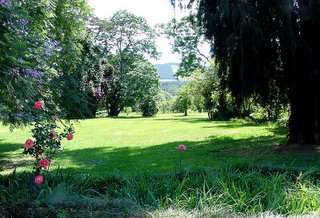 Fern Hill, our hotel in the Midlands, had a beautiful park-like setting. This was the view from the window of our room.
 From the tea garden at Fern Hill we could watch the birds flit through this tranquil water feature.
 In America we call this a Blue Gum Tree, but in South Africa it is known as a Jacaranda. Fern Hill had an abundance of these delicately-leaved lavender-blossomed beauties.
 These papyrus guard the entrance to the Jacaranda Tea Garden at the Fern Hill Hotel. They are the tallest papyrus...more than 12 feet (4 metres) tall...I have ever seen!
In the Midlands town of Howick, at the end of a narrow walkway bordered by little craft shops, we found this sweet little oasis.

Big Bertha earned her stripes...and a new nickname, "Dirty Bertie,"...on roads like this one. In fact, this was one of the better ones. The greenery in the Midlands was lush and thick at every turn.

Flowers grow wild along the side of the roads, the tar roads as well as the dirt roads. Here is a heap of roses growing on a fence along a main road.

Sunflowers found growing beside a railway bridge abutment

Even calla (arum) lilies grow wild in little swales by the side of the road.

And there is the bouganvillea...

The grounds of the Dargle Valley Pottery were one of the greenest, lushest sites we visited...and it was down one of the darkest, narrowest, most poorly marked roads we encountered!

A field of yellow blooms at the Lion's River Trading Post.

We found a dense copse of blue hydrangea at Mill Cottage in the Midlands.

And an even thicker copse of hydrangea at the Fort Nottingham historical site,...which is way out in the countryside on a really rocky dirt road...outside a quaint little half-timbered building sporting an engraved brass plate identifying it as the consulate of Madagascar!

There are many marshy spots in the Midlands, and dams (ponds, to Americans) are in abundance. Here a little Red Bishop perches on a reed, guarding his nest.

Outside our room in St. Lucia there was this huge tree, a vlamboom (flame tree) thick with blazing red blooms.

Outside the little convenience store in Cape Vidal we discovered this pair of trees, one wrapped completely around the other via these tendrils. The host tree did not appear to be suffering from its partner's embrace.

I've seen a lot of acacia trees since I've been here...they are very common...but these blooms are the first of this kind I have ever seen.

South Africans are familiar with the thorny acacia trees, but I had never seen one like this until my first visit to South Africa. These thorns are long, vicious and really, really sharp.
Isn't this a stunningly beautiful country?
Saturday, January 07, 2006
Goodbye to St. Lucia

There were no places to buy food in the game reserve so we had to head back to St. Lucia, an hour's drive, so Dear Hubby could have lunch...skipping a meal is simply not acceptable when you are diabetic. En route back to the Nyalazi Gate, entrance to the reserve, we found ourselves cresting a hill and seeing two vehicles pulled to the side of the road at the base of the hill. Obviously they were observing something, so we approached slowly, on the alert. Just as we pulled level with the other cars I spotted a small group of elephants clustered under some trees. Hubby pulled the car to a stop as I put the window down and stuck the camera out the window. Unfortunately, as I did so, this guy swung his head in our direction and began to fidget his front feet and bob his head. With Gavin's story about the park employees killed by elephant still fresh in my mind and this guy starting to advance on the car, I hurriedly snapped this shot and Hubby got us quickly away. We came across several groups of rhino, this one being the closest to the road. For some strange reason, none of the pictures we got of any of the rhino showed their upper lips, so we were unable to determine if they were white rhino or black. Before this trip I had expected that we would find the rhino dangerous and the elephants calm...surprising that I found it to be just the opposite, the rhino quietly grazing by the side of the road but the elephant threatening.
 We returned to St. Lucia and grabbed lunch, then headed for the local open-air market, located in a huge boma beneath the most beautiful vlamboom (flame tree). Beneath the shade of the boma were the fresh fruit and veg vendors, their tables a colourful mélange of pineapples and mangoes, pawpaws and bananas, tomatoes bursting with ripe freshness. In front of the boma, under the spreading branches of the vlamboom, were the curio sellers. Woven grass beach mats, hats and tote bags, hand carved representations of local birds and other wildlife, lengths of hand-dyed fabric, rag rugs, and at one end of the line up, a stunning hand-hewn three legged table.
 We had had lunch the previous day in a restaurant called Für Elize, a place that seemed to specialize in crocodile dishes. While awaiting our meal (fast, efficient service not being one of the hallmarks of this establishment in particular and St. Lucia in general), I studied the structure of the boma in which the restaurant was located and the décor, most of which was of local origin. It was here that I saw one of these tables, a charming blend of European lines and African originality. Unfortunately, none of the curio stands we saw during our travels exhibited such a table, but on this particular visit to the open air market, we spotted one and, after a bit of negotiating (Hubby is a great haggler!) the table was mine for only R150! ($25). It now sits in my hallway, supporting my Ardmore pot...which we picked up at the Ardmore pottery in the Midlands...and a frothy little house palm.
The morning we left St. Lucia the temperature was 30C as we loaded the car. We were on the road back to Durban by 9 am, retracing our steps through the sugar estates, our first leg of the long journey home.
Friday, January 06, 2006
Dirty Bertie earns her name...
We had dinner on Saturday evening at Alfredo’s, an Italian restaurant located in a complex of small apartments, and sat outside near the pool. Cuisine is not a priority in St. Lucia, which undoubtedly explains the presence and popularity of the Ocean Basket, but Alfredo’s did a passable pasta. While sitting outside we were visited by a rather friendly cat and when Hubby inquired if it was the restaurant’s cat, the server replied “Oh, no…this is St. Lucia’s cat!” Rather than find feral cats a scourge, as we seem to do in America, the town of St. Lucia has adopted these homeless cats, allowing them to roam freely through the outdoor restaurants and holiday accommodations. We met at least five cats during our stay, all of whom were friendly communal cats, well fed, friendly, and a delight to the tourists.
Gavin had suggested that we go to Imfolzi or Hluhluwe, game reserves across the highway from St. Lucia, if we wanted to see elephants and rhino, their local brethren having been rather shy with us. So, early the next morning we rose to a breakfast of pineapple and orange juice, loaded up Bertha…which had acquired the nickname “Dirty Bertie” by this time…with cold drinks and snacks, and headed for Hluhluwe (“shuh-SHLU-wee”). As it turned out, Gavin had given us an excellent suggestion. Almost immediately upon entering the park, we met up with a giraffe having an early breakfast. Ignoring us as if we were not even there, he browsed the top of a stickery acacia tree, calmly chewing and looking as if he hadn't a care in the world. I've seen giraffe in zoos...the San Diego Zoo is one of the finest in the world and I have been there more times than I can remember...but nothing prepared me for seeing this long-necked giant nonchalantly chewing the top off a tree from the side of a road! Encountering him had been quite a surprise ad we had not expected to find wildlife within minutes of entering the reserve, but we drove around a curve in the road and there he was!
 At the entrance gate, when he paid our fees, Hubby bought a map book that turned out to be invaluable. Not only did it show the various roads and view spots in the park, the back of the book contained excellent drawings of the resident animals, enabling us to identify many of the creatures we sighted. Impala...the antelope after which one of Chevrolet's most successful models was named...are tiny little creatures! I had expected a larger, bolder, more impressive looking animal, so the slightness and delicacy of their body structures really surprised me. They are reputed to be shy animals, but the were the single most common species we encountered and while I wouldn't call them exactly friendly, they were not easily spooked. We came across this cautious mother and curious baby as part of a larger herd.
 The juvenile bucks engage in mock battles, practicing for the day they will challenge other bucks for mating rights. We drove over series of hard-packed dirt roads, watching for game and, cresting the top of a hill, we spotted a herd of perhaps fifty impala spread out across a rolling meadow. In one swale three pairs of young bucks were hard at work honing their fighting skills. Like the giraffe, they ignored our presence, not even stopping to look and assess whether or not we represented a threat. These youngsters do not yet have the distinctive horns of the impala buck, but the black patches on the ankles mark them definitively as impala.
 Adult impala males, small as they are, carry an impressive set of curved horns (or are they antlers?) This buck, tiny and delicate as he may appear, is an experienced fighter, else the herd of females, babies and young juvenile males we found him with would belong to a stronger male. Behind him in the grass is one of the ubiquitous termite mounds (no, it is not a rock)...a rather small one, actually. These mounds dot the landscape of South Africa like so many freckles.
 Twenty kilometres beyond the entry gate, the tar road played out and the rest of our morning was spent on dirt roads in varying states of disrepair. We went through dry riverbeds, the roadway simply a path of hardened mud and bumped through ruts and over rock, thankful to have brought Bertha on this holiday...there was no way the Pretty Baby (Hubby's Honda S2000) would have made it through this! Five kilometres or so beyond the Mpilo camp (where the tar road ended) we came upon a view site, the most impressive sight being this warning sign at the head of a hiking trail. I started wondering what kind of people came down here to holiday...water skiing in crocodile-infested waters, hiking on trails where you are likely to encounter lion, hyena, leopard, buffalo, rhino and elephant...not to mention the poisonous snakes and the fierce South African sun...are they certifiable or what?
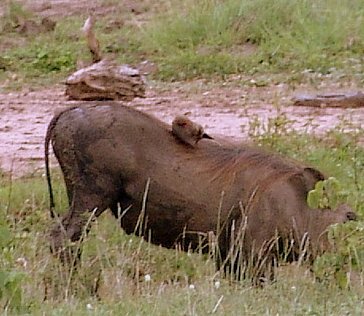 Our first warthog sighting was disappointing...the animals were in thickets the camera could not penetrate and when they broke out into the open, they were moving too erratically and swiftly to get good pictures. The tar road had long given way to dirt, but now we were encountering "loops"...lesser-travelled dirt tracks that looped back onto the main road. Hubby turned Bertha onto the Sontuli Loop and things began to liven up. One of our first encounters was a small family group of warthogs, one of which had a bird riding on its back. Warthogs often have symbiotic relationships with small birds that keep their skin free of ectoparasites such as lice and ticks, and this one simply rode the warthog much like I might sit a docile, well-trained horse.
 On our drive with Gavin we spotted a couple of wildebeeste (gnu) under a tree, but they were too far away to photograph. He told us that they were...well...not the rocket scientists of the veld. I don't know how accurate he was, but you have to admit that the face does convey an impression of dullness. He stood and watched us for a few minutes, moving forward and back a bit as if unable to decide whether he should come investigate the car or flee. Despite its size, the wildebeest is not known to be an especially aggressive animal, so we simply observed him until he eventually just ambled away, apparently unimpressed with and unalarmed by either us or Bertha.
 Buffalo, however, are dangerous, hostile, stubborn animals. Gavin told us of an incident at a game reserve where he used work in which a person was killed by a buffalo bull. The animal, wanting to be sure the person was dead, stood over the body, occasionally assaulting it, for three days before being sufficiently certain of the man's death to move on. This bull didn't look exactly pleased with our presence, so we made ourselves scarce after snapping only this one shot. Often these animals have bird passengers as well, but if I was a bird, I think this guy's mug would definitely put me off!
Unfortunately, there were no restaurants or snack shops in the reserve and so after taking two of the loops and finding an abundance and variety of animals beyond our expectations, we had to head back to civilization...lunchtime was approaching and Dear Hubby is diabetic and skipping a meal is not an option. But as much as loop roads had revealed that variety and abundance of wildlife, it was not until we were on our way back to town that we finally got an up-close-and-personal look at the beasties we were specifically hoping to see...the rhino and elephant.
Next entry, you'll see them too.