
Point Agulhas is the southern-most point of land on the Afrikan continent. Much to our surprise, there was a thriving community there, unlike the uninhabited wilderness of Cape Point.  Here is a peek at a part of the fishing fleet.
Cape Town's conceit notwithstanding, the two oceans meet here, at L'Agulhas, not further west along Cape Town's extended environs. You can see the marker but the confluence of the oceans doesn't appear to be particularly roiled up. We saw more exciting surf at Hermanus the following day!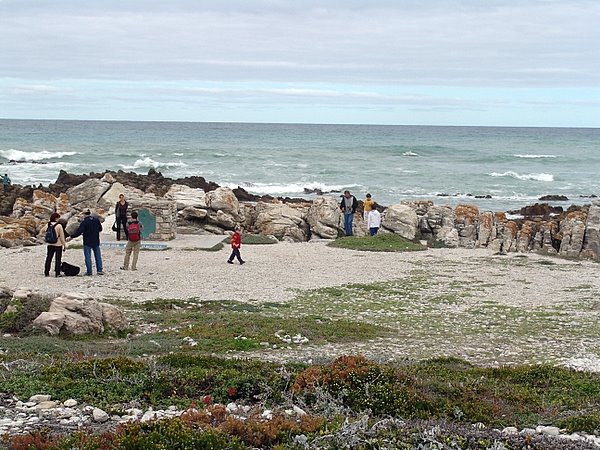
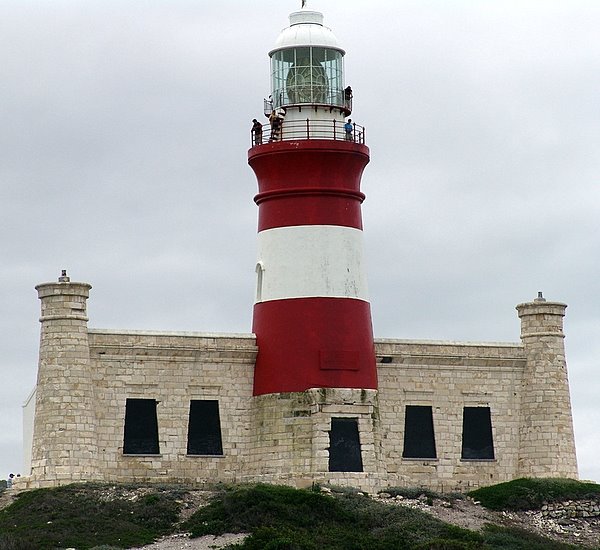
I didn't get any details on the lighthouse, but it's easy to see that this is one very old building! We wondered if those oddly shaped doors might be gunports for old cannon, particularly since the entrance to the lighthouse is on the sheltered side. The old limestone blocks are weathered, but don't appear to have eroded significantly over the centuries. Wonder what those two towers are for?
This flower is the most uncommon-looking thing! There are no leaves, no plant, just this gorgeous translucent bloom thrusting itself upwards from the gravel and rock at the shore. We saw dozens of them, scattered in groups of three or four, their scarlet faces a stark contrast to their barren surroundings.
Next entry: after Hubby spends a dismal night with what he is certain is food poisoning, we awaken to a fresh, light drizzle that doesn't grow into a driving rain until we are on the road. Undeterred...and Hubby's tummy still a bit touchy...we head for Hermanus for lunch and find an upstairs restaurant with stunning views of the storm-tossed coast.
Thursday, April 20, 2006
A View from the Overberg, Pt.3

Tuesday, April 18, 2006
A View from the Overberg, Pt 2
So, we left the luxuries of WedgeView (where their premium breakfast is called a "Wedgie") and hit the road for Swellendam. After a couple of hours of ruddy barren fields dotted with the occasional dorpie for a view, a speck of green came onto the horizon, swelling in size with each passing kilometre until we could see the lush green of a town. Swellendam is the third oldest city in South Africa and it is situated along the Breede River, and is immensely fertile. After passing an industrial area, remarkable for the immense grain silos along the roadway, we came into the verdant little town.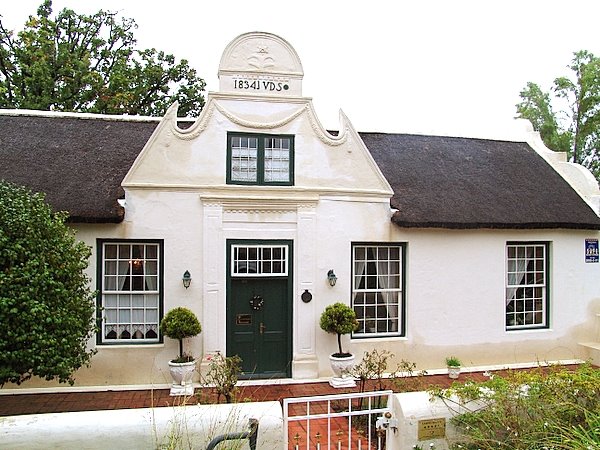
After a right turn onto the main road, Voortrek, the fourth building on the right was our destination: Rothman Manor, a Cape Dutch house built in 1834 and the first in a complex of buildings that makes up this five-star, three-hectare establishment.
The owners, Franziska and Andreas Goebel, are a German couple, a fact reflected in the interior design of the rooms. While the rooms aren't decorated to reflect the historic nature of the property, they are beautifully and luxuriously appointed. We found some unexpected amenities...underfloor heating in the bath (which was tiled with black granite), the guest's cars washed daily, and a well-stocked minibar with fridge snuggled away in the side compartment of what could only be a custom-built desk.
The property includes a huge lily pond, the original dam has been converted into a koi pond (and those koi are HUGE!), a swimming pool and a jacuzzi, and a small private nature reserve that contains deer, zebra, and ostrich (http://www.rothmanmanor.co.za/). A few pics: The lily pond
 Honest...there is an ostrich in this picture!
The two little deer are a bit easier to find than the ostrich was.
These are the biggest koi I have ever seen!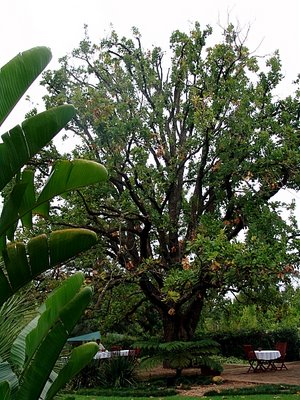
To call the town of Swellendam "quaint" would be a gross understatement. The place is full of buildings two and three hundred years old, most of them in excellent repair and currently occupied. Rothman Manor has an oak tree more than 200 years old under which breakfast is served during appropriate weather.
After a good night's sleep and a hearty breakfast, we set off exploring and ended up at Cape Agulhas, the southern most point of land on the African continent. Next entry: the Indian and Atlantic oceans meet in front of a stunning Old World lighthouse.
Monday, April 17, 2006
A View from the Overberg
Here in South Africa, Easter occasions a four-day weekend and South Africans just love to take to the highways and byways at such times. With the rotor for Koeberg's downed generator safely arrived, Dear Hubby was able to actually take the holiday and Friday we headed out for parts unknown (at least unknown by me).
Our first night on the road was spent in Stellenbosch, only an hour or so away by road, but a world away in amenities. Hubby found a delicious country house...located a couple of kilometres out on a gravel road...and dear old Bertha again did us proud, eating up the bumps and lumps like the trouper that she is. At the end of the dusty journey we found this: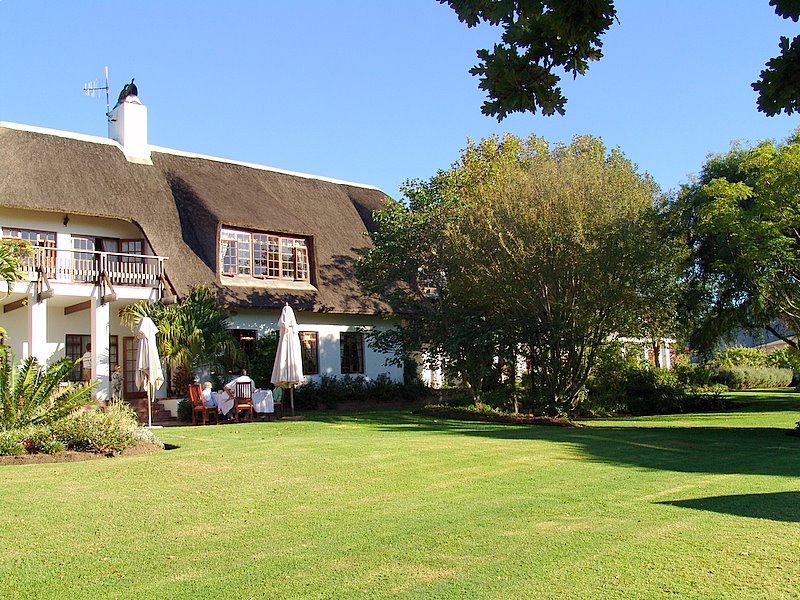 When have you ever seen something this gorgeous? I was stunned! It was the most beautiful place, with 360 degree views of lush vineyards and beautiful mountains. And it had a luxe spa where I sent Hubby off to have his poor tired feet tended with a reflexology session and a pedicure (he's diabetic and must be very good to his feet and he'd been standing on them for days with that rotor arriving in town!).
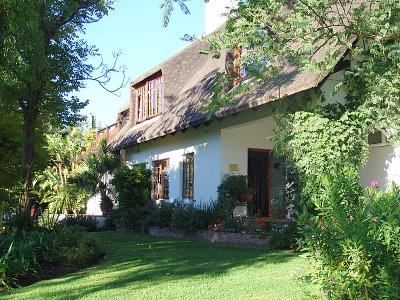
This is a five-star country house called "WedgeView." The host and hostess, Mike and Trudie Spicer, are British and they immigrated to SA about 9 years ago. Trudie is a true horticulture nut, and the absolutely gorgeous gardens (not to mention the impressive koi pond) are both soothing and stunning at the same time. Here are a few more pics of WedgeView (www.wedgeview.co.za) :
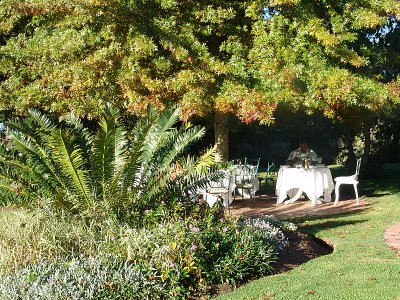 Hubby having breakfast on the terrace (above). Notice the huge cycad to the left.
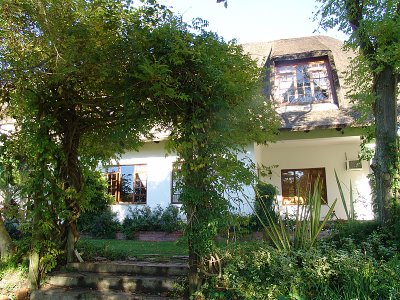
The food was delicious (the quiche was absolutely wonderful!), the service beyond reproach, and the room was spacious, beautifully decorated, and deserved every one of those five stars. We were so impressed, in fact, we plan to return to WedgeView when we have the time to stay more than one night and really make a retreat of the place!
In the morning, after a solid night's sleep, we packed Bertha back up and headed off for our ultimate destination: historic Swellendam and the historic manor house, Rothman Manor (est. 1834), set on 3 hectares of stunning land right on Swellendam's main road! More pics tomorrow.
Wednesday, March 15, 2006
How rude!
Dearest Hubby took me out to dinner last night for my birthday. I had expressed a wish for sushi, so we headed to the nearest Cape Town Fish Market and ended up at the one at the Paddocks in Milnerton, near Woodbridge Island. For those of you who aren’t familiar with the area, it is an upmarket area and the restaurant has a view of the island, the sea, and Table Mountain.
The sushi bar was busy, full of the rich and the trendy, but we managed to find two seats and began ogling the tempting array of dishes rolling past on the little motorized conveyor belt. The sushi bars at Cape Town Fish Markets are long oval affairs with the sushi chefs on the inside of the oval preparing the sushi, the patrons seated on the outside, and a segmented conveyor belt endlessly rotating, carrying the tender morsels past each customer. When something comes by that you like, you simply lift the little plate from the conveyor, place it in front of you, limber up the chopsticks, and dig in.
Because most diners only take a plate or two at a time and the chefs are continuously busy adding new dishes to the conveyor, you seldom have to wait more than a few seconds for something tempting to pass before your eyes. Despite the fact that the place was crowded, things were going along swimmingly, the regularly occurring empty spots being quickly refilled by the busy chefs. And then the Greedy Twins came in.
I don’t know what some people have against taking their turns. What makes two people so oblivious to the local custom…and the feelings of the other patrons…that they can come in from nowhere and lay waste to the evening’s offerings? A man and a woman walked up to the sushi bar and, without taking seats, began snatching things off the conveyor belt and covering the bar in front of them. They were to my right and the conveyor was moving in a clockwise direction so, instead of the occasional empty space on the belt as it passed before me, suddenly there was the occasional dish of sushi as an empty belt rolled by! Slowly, patrons began looking up from their conversations and casting their eyes around the bar, wondering where the food went, while Piggly and Wiggly added to their ever-growing stash.
What really ticked me off was that the management and wait staff didn’t seem to think there was a problem here. When P&W shoved everything in the direction of a waiter and demanded it be packaged for takeaway, someone should have noted down everything on the bar, returned the food to the conveyor so the other 40 or so people at the bar could eat, and told Piggly and his Wiggly gal pal to have a seat while the chefs prepared their takeaway for them!
As it was, even the painfully thin, brutally nipped-and-tucked Paris Hilton wannabe at the other end of the bar took notice of the barren belt…I doubt she ate more than one California roll at a sitting, but even she saw that the bar full of patrons who arrived ahead of these boors were staring at a barren larder as the latecomers packed it all up and carried it away. It took the better part of half an hour to restock the conveyor, during which time more than a few patrons settled their bills and went home…we among them. After all, if you’ve come to eat sushi and suddenly the cupboard is bare, why hang about?
I have to wonder if those people had any idea how rude they were and how they, basically, shoved themselves to the head of the queue and then took almost everything on offer, leaving a good three dozen people staring at empty space where their dinner was supposed to be.
Nah…if they had a clue, they wouldn’t have done it…would they?
Tuesday, March 14, 2006
Another year gone by...
Today I am 59 and I have to ask…when does menopause end?
I told my Dear Hubby yesterday that I have just one year left now, that I am capable of the kind of sleight-of-mind necessary to stretch the definition of “middle age” to cover the fifties, but nobody, not even me, can call 60 “middle aged.” In 365 days, I will be officially old.
Funny, but I don’t feel old. I don’t even feel old approaching. According to most people who know me, I’m not looking particularly old, either…but you know friends and family…they probably wouldn’t tell me my age was showing even if I was down to no teeth and wrinkles so profound I was tripping over them. While having my roots touched up last month (yes, I am a natural blonde, just not this naturally blonde) I asked my hairdresser how much grey has sprinkled itself into my tresses and she said about a dozen…I have to believe her because the reason I asked is that I didn’t see any when I checked and Hubby, a wise man who knows when to keep his own counsel, wouldn’t admit to having found any!
While I am postponing the admission of being old, I cannot escape the fact that I am aging. Of course we are all aging…we begin doing that the day we are born…but there is a certain point in life when we look at ourselves in the mirror and realize that some things in our lives are not only gone, they are gone forever…like perky boobs or an unlined brow…and some things are here to stay…like crinkly skin and sagging jowls. Time and gravity take their toll and at that certain age…if you aren’t one of those pathetic people showing your wrinkled belly to the world in obscenely low-cut jeans and your pre-teen granddaughter’s cropped top…you simply cannot deny it any more.
I don’t know if men have a biological rite of passage out of youth, but women do. It’s called “menopause.” We can hand over our pension savings to the cosmetic surgeon, with his scalpels and lasers, suctions and injections, and come away with a temporarily updated version of ourselves, but we can’t fool Mother Nature and our ovaries. At some point in life the oestrogen factories start shutting down and middle age comes firmly upon us, like it or not.
Menopause has been likened to a latter-day menarche, just in reverse. Girls’ bodies gradually prepare themselves for the onset of womanhood and, once the ovaries kick into gear, there are a few years in which the hormones have to get settled down into a predictable flow: adolescence. We know, however, that this “adjustment period” will eventually end…at least physically…and once it is over and our bodies are acclimated to the new chemical brew, life goes on. One would expect menopause to work much the same way, but in reverse: a period of time in which the body reverts to its previous low-oestrogen state, followed by an expanse of years in which we are no longer tormented by cramps, PMS, monthly indispositions, or rabid curiosity about the latest and greatest advances in contraception and feminine hygiene products. And, indeed, that is our eventual destination but just how long is this journey and just how rocky is this road?
Fully twelve years ago I remember getting up from my desk and heading for the copy machine and nearly fainting half way there. Now, this is wholly unlike me…I am one of those indomitable types who would be at the very bottom of your list of “women most likely to faint for any reason whatsoever.” I’ve administered first aid to auto accident victims with gruesome injuries, I’ve endured a robbery in which I was assaulted with fists, feet, and knives, I’ve suffered the sudden and unexpected death of my dearest husband, and sat vigil at the bedside of a comatose infant. If that which does not kill us makes us strong, then I’m among the tougher of my sisters…so what is this nearly fainting half way to the copy machine crap?
So, I figured I was just standing up a bit too fast…blood rushing out of the head sort of thing…so I tried rising from my chair more slowly and, instead of rushing to the copier, being more measured in my approach…to no avail. Half way to the copier, I was feeling faint again. After a few more episodes, one in which I actually saw stars and swirling black clouds, I made it a point to visit my doctor. She gave me a prescription for female hormones and when I objected, she said “just try it for a couple of weeks…trust me on this…” Amazingly, my near-fainting spells cleared up in less than 48 hours and, thankfully, did not return when I stopped the hormones.
A dozen years have passed and, frankly, I have no idea why I am still experiencing symptoms. Oh, the fainting spells are gone and I am finding the odd stray dark hair in places more appropriate to my husband that to me (I’m beginning to think that the Bearded Lady of circus lore was simply any post-menopausal female who has lost her tweezers!), but the classic symptoms don’t seem to want to give up their hold on my physiognomy and retreat into the mists of history: I am still getting random hot flashes, especially at night. I am convinced that the sleep disturbances that are a legendary part of the “change” are really nothing more than nocturnal hot flashes that require the sufferer to awaken to some degree in order to alleviate the discomfort…remove the blanket…remove the sheet…remove the nightgown…remove the husband…point the fan directly at the body…and now you’re awake!
Unlike some women I have known, the hot flashes haven’t been such a problem for me. Some women have told me about trembling spells of rushes of body heat, sweat pouring down their brows, and noticeably reddened faces…I’ve never experienced anything like that, just a mild, uncomfortable overheating, easily remedied by a small fan directed at the face for several hours at a time. My doctor tells me that this is due to my excess weight, that fat tissue produces oestrogen and helps to mitigate my symptoms…who knew?? A positive side to being a pudgy! But that fat tissue must be sleeping at night, right along with my consciousness, because at two in the morning, with a fan trained on the bed, I find myself awake and rearranging the bedclothes and rolling Dear Hubby to the far side of the, thankfully, king-sized bed!
So, maybe the difference between being old and being middle-aged is less one of a number of years achieved and more of development. My body seems to be stuck firmly in the middle ages, and my husband (who is considerably younger than I am) tells me that I will never be old because I don’t know how to be (such a sweeeeet man!).
I dunno…I guess I’ll have to check next birthday and see how I feel then…
Saturday, March 11, 2006
Of bugs and women...
I detest insects. Yah, yah, I know about their place in the ecosystem and all that stuff, but surely expecting them to keep to all but the 255 square meters of this planet I call my house cannot be called unreasonable, can it?
Oh, there are a few of the multi-legged little wretches I find tolerable…lady bugs, praying mantises, dragon flies and, of course, butterflies (although not their creepy little garden-devouring predecessors!)…yup, that pretty much makes up the list. Everything else that ambulates on more than four legs is, as far as I am concerned, a candidate for immediate extermination.
I come from a family of long-lived women. Most of us have lived well into our seventies, and more than a few have marched strongly through the eighties. That being the case, I expect to pack a few more decades under my belt before permanently packing it in…and I would just as soon not hasten my demise by poisoning my environment with toxic chemicals and the like. That is not to say that I won’ use insecticides…I most certainly will! But I have a strong preference for using other, non-toxic methods where possible. Hence my affinity for certain insects that devour their hexapod cousins, such as the lady bug (she loves aphids), praying mantises (anything that comes within range!), and dragonflies, the nymphs of which prey on the larvae of mosquitoes just as the adults eat the nasty little biting buggers themselves. I have a strong affinity for passive, non-toxic, low-maintenance insect control.
Early this week we had a bit of excitement in the house. Priscilla, one of my friends, had dropped by and as we sat at the table chatting, the maid started up a hysterical babble in Xhosa at the front door. She was flapping her broom at a corner and, being rather arachnophobic, I immediately presumed she was trying to kill a large spider…certainly a small one wouldn’t cause such a ruckus? Priscilla interceded, translating for me, and it came to light that the creature causing the commotion was a thoroughly frightened and absolutely cowed little gecko about 12 centimetres long. Swooping down between broom beats, I snatched his tightly curled little body out of the corner and carried him out to the patio, trailed by a wide-eyed Priscilla. I tried to put him on the wall of the house where he could run up and hide in the ceiling boards, but his little gripper pads were tightly adhered to my rescuing fingers and, while explaining to Priscilla that geckos ate bugs and were not poisonous, I carefully unstuck his little feet from my hand. I was actually able to persuade her to lightly run a finger over the little guy’s tail before I put him on the wall and he scurried to safety.
“Never kill a lizard,” I advised her. “There are no poisonous lizards in South Africa and they eat bugs.” I went on to explain that small geckos like the one I had just rescued from a horrible death-by-broom ate such things as mosquitoes and ants, while their larger cousins would make a happy meal of cockroaches and other large insects. “They’re cheaper than Doom,” I told her, “and don’t leave poison around to make your child sick!”
My mother-in-law, who is South African and who has lived her life in Durban, takes a dim view of my dedication to my lizards. Last year I rescued a small chameleon from death-by-curious dog, and at one time in America I kept horned toads (a rather disc-shaped American desert lizard) in the house as a control measure against the cockroaches and other creeping creatures that took possession of the house every night at dark. Like the maid, my mother-in-law attacks the beasts with a broom, although I must commend her for her restraint when I am about, even in her own house. She will even point out to me the occasional iguana clinging to the garden wall rather than beat it away with her broom, and when she is at my house…although I know it costs her greatly…she ignores the little visitors that often festoon the walls.
Occasionally I find a little black curl of gecko exhaust on the tiles, confirmation of their predatory efficiency. My mother-in-law finds this evidence of their existence objectionable, but I simply remind myself of how many dead bugs it must have taken to produce that bit of effluent and carefully remove with a bit of tissue to the loo…a small price to pay for the elimination of the little multi-legged trespassers!
Last night we spotted a new gecko prowling the upper reaches of the bedroom walls, a tiny little fellow no more than 4 centimetres long. He made his way behind the armoire and spent the day snoozing back there, re-emerging this evening to prowl the walls again. I’m happy to see him…I hope tomorrow night he returns again and this time brings his big brothers…
Saturday, February 25, 2006
The myth that will not die...
I’ve been having some work done in my house. The previous owner did some remodeling and one of the things he did was replace the original lighting in the kitchen and dining room with down lighters. These give a nice, almost indirect glow of light to the rooms…but only when they work. And there’s the problem…almost half of them don’t work. The last owner also remodeled the kitchen and, while the effect is quite nice, he didn’t leave much space for a fridge. That hasn’t been a problem up to now, since Hubby’s fridge was narrow enough to fit the space available. Unfortunately, the fridge has fully packed it in (not a heartbreak for me since it is waaayyy too small) and we decided on a side-by-side so we could have enough freezer space for more than a carton of ice cream and a bag of frozen veggies. So, I’ve had workmen at the house moving a bank of cabinets to make room for the fridge and pulling the light fixtures out of the ceiling to see why they won’t light up.
Thursday (yesterday) is ordinarily a busy day around here because both the maid and the new gardener work. Yesterday was particularly hectic because the handyman, Graham, was added the mix, along with the delivery of the massive monolithic slab of white steel that is my new refrigerator. It was hectic…the cupboards slated to be moved first had to be emptied, which left the dining table and all available flat space covered with a muddle of dishes, bowls and tchotchkes, and the normal Thursday cleaning had to be done around the jumble. And, throughout all of this, the threat of further power cuts hung over our heads, prompting everyone to gou maak with the tasks that required electricity before we once again found ourselves cast back into the Dark Ages for a span of hours. When we sat down to lunch on the patio…the dining table was still buried under a mountain of cupboard disgorgings…we had a moment to chat. Over roasted chicken and koeksisters, Graham, who is a member of a three-man handyman team and new to our household, asked the inevitable question: why on earth would I leave the bounty of America for a place like South Africa? Christopher, the new gardener, chimed in saying that everybody knew that America was a rich place where nobody had to live in shacks and everybody had a job…a good job. I had to shake my head.
How does America manage to export this myth and…more to the point…keep it alive? Don’t tell me it’s movies and TV…American movies and television show the ugly underbelly of crime, poverty, substance abuse, abuse of authority, and homelessness right along with the vast expanses of neat middle class tract homes that look like they could have been teleported direct from the Cape Town suburbs and dropped, unchanged, onto American soil. Perhaps America is not so much exporting the myth as other nations are casting America in the role of a secular heaven…an idyllic land of universal wealth, a place where you need only arrive on its shores to be showered with everything your heart desires. I really don’t know. But what I do know is that the image of America in the eyes of much of the rest of the world has very little to do with the reality of the place.
One of the most frequent questions I am asked here is why would I want to leave America for a place like South Africa. It still makes me laugh because the query itself reveals at least two things about the questioner: a dismal ignorance of the reality of the US and a serious lack of appreciation for this country. My standard answer is “My husband and I did the math: we can live better here on one income than we could live in California on two.” This answer is universally met with raised eyebrows, but it is the truth: we do live better here on one income than we could in California on two. Yes, there are cheaper places to live than California, but if we are going to compare apples to apples here, we have to stick with comparable locations: I didn’t live in the American equivalent of Pofadder or Mamelodi, I lived in an area much like Cape Town, both in terms of affluence and climate.
The first thing people find shocking is the news that domestic workers are very rare in America and very expensive. Graham asked me if that was even true of people who had several children and both adults worked…his eyebrows took a rapid trip upwards when I replied that was especially true of such people. People whose jobs put them at the very top of the earning scale…the American equivalent of managing directors, for example…might have domestic help, but those domestic workers often earn more than their PAs. This is no bull…I was an executive PA in the states and at my last job (2003) I earned $216 a day (a respectable but not especially high wage for an executive PA)…I had to pay a domestic worker $250 for one day’s work cleaning my house…and that was after every stick of furniture had been removed from it! My boss, the one who paid me $216 a day (and that is before deductions for various taxes which ate up fully one third of the gross amount) paid more for her Tuesday cleaning lady than she paid me. And a gardener who will come and work a whole day in your garden? Forget it! You can get casual labourers who speak little or no English for $10 an hour if you are willing to pick up strangers standing on a street corner, but a regular garden worker? Or even a garden service to mow and trim? Very, very few people employ such a service domestically.
Living in America is very costly. The American dream of owning your own home is increasingly out of reach of Americans. A co-worker of my husband is a young (24) single female professional…an engineer. She has just started her career…she has been employed for about a year. She has already bought a brand new car and a townhouse. She can afford, on her income alone, to do this. It is not because she is being paid an extravagant salary, but because the ability to buy your first home on a single professional income is alive and well in South Africa. My husband did the same thing in 2002…he bought his first S2000 and a four bedroom house in an upmarket Cape Town suburb, all on his income alone and without borrowing a cent from family members. This is simply impossible in the place I lived for the last 30 years in America.
There are always going to be people who will dispute, on the basis of their own (or a friend’s) brief sojourn in the US, the things I relate here about my homeland, but it is my opinion that knowledge gleaned through more than fifty years of living there is a bit more reliable than a few anecdotes collected on a holiday visit or even a short residency. I didn’t live in one isolated corner of the country, either, so I have a bit of perspective on more than just California…I lived in four of the fifty states, visited more than two-thirds of them, and lived in three distinct parts of California (the third largest state in geographic area and the largest, in terms of population). California is a long and narrow state that takes up more than half of the western coast of America, and the various regions of that state are as distinct from each other as chalk from cheese. I lived just south of San Francisco from 1974 to 2004, an area colloquially known as “Silicon Valley,” and I worked in the high tech industry for most of that time. I owned three houses during that time, raised three kids, was married, divorced, remarried, widowed and married again there. (Earlier in my life I also lived in San Diego and Santa Barbara.) I have been in Cape Town for two years now and I can assure you, Cape Town is more like the parts of California where I have lived than different from them, the primary difference being cost.
South Africans nurture a notion that America is virtually crime free, a fatuous notion that sometimes amuses me greatly. I had locks on my doors…and on my windows. Many of my neighbours had alarms on their houses (even in middle-class neighbourhoods that didn’t hold the promise of riches to be found in upmarket areas). My neighbour across the street had bars on all her windows and a security door, and the man next door had an iron cage around his front door. Few American houses have masonry walls around the front of the property but the reason is NOT because crime is non-existent…it is because the police have told us not to do it because once a burglar scales that wall, he cannot be seen by neighbours or passersby…it protects him from discovery. Police also tell us to keep hedges and bushes near windows trimmed down to prevent the burglars from having hiding places, and to make sure trees and trellises to not afford robbers a means to climb up into our second stories.
America has gangs. When I was a youth, they were pretty much an East Coast thing, but by the time I reached adulthood, they were all over the country. With them came new words in our vocabularies: “drive by shooting” and “turf war,” for example. There were the Bloods and the Crips, the Norteños and the Sureños, and they ran unchecked through our streets, our schools, our prisons. America has school shootings and drug dealing and violent attacks in the schools: students all over America are checked daily for weapons when they enter their schools, and yet assaults, including shootings, continue to happen (one in Roseburg, Oregon…a quiet little town I have visited many times…just this week). It is not unknown for a student to be killed by another student because he would not give up his new Air Jordans or leather jacket or simply because he wore a shirt in a colour that one gang or another had declared as its own. America is not free of violence or crime and you are no safer in your home in San Francisco or Salt Lake City than you are in Cape Town…for a chilling illustration of this fact, Google the names “Polly Klaas” or “Elizabeth Smart,” just two of numerous American girls who have gone missing in the night from the supposed safety of their own homes.
Americans are not all rich, nor do even the majority of Americans work at jobs that pay them princely wages. That staggering $216 a day I earned as an executive PA was a paltry sum when measured against the costs of mere survival in my area. I inherited a 40-year-old house (along with its bond) that cost me $1550 a month plus gas, water, electricity and telephone, just to keep a roof over my head (easily another $500 a month). Then there were things like petrol for the little bakkie to get to work ($40 a week and going up every day), insurance for the bakkie (mandatory under state law and $150 a month) plus little incidentals like groceries, doctor bills ($300 a visit since I had no medical aid), clothing. That seemingly comfortable wage was subject to tax…deducted before I received my pay, and when the tax man got done with me each month, I had to make $3000 stretch to cover everything. It wasn’t easy because, invariably, something unexpected would always come up, like a burst water pipe or geyser, new tyres for the bakkie, a leak in the roof…there was always something. When you consider that I was supporting only one person on that wage and it was so much of a struggle, imagine what people with kids go through! (And, to any person who wants to suggest that I should have sold the house and gone to live in a flat, those bond payments…on a 20 year-old bond…were considerably cheaper than rent on even a small flat. My bond was $1550 per month…the people who bought my house took out a bond with payments of more than $4000 a month and she was an executive PA like me…and her husband was an engineer like mine…and they didn’t have any kids to support, either. The bond payment was more than her gross salary, and this was for an older house in a working-class neighbourhood!)
America has poverty…real poverty. People live under bridges and beg in the streets in America. They sleep in parks and doorways and in makeshift shelters made of cardboard. They live in old cars with their children, or in tumble-down shacks without running water or as squatters in abandoned buildings that have no power. They eat out of dumpsters and go hungry, every winter people literally freeze to death on the streets in the winter, and there is no child maintenance money guaranteed to indigent mothers…Americans are as unsympathetic to their own poor as they are sympathetic to the poor of other nations. The gardener was astonished to learn that my life started in a little two room shack with no running water, that I was intimately familiar with the long-drop toilet (called an “outhouse” or “privy” in America), as my grandmother did not get indoor plumbing on the farm until long after I had started school (and moved to the city). I know about homemade dresses, shoes with holes in the bottoms, letting out the seams and hems of my dresses so I could wear them another year, and colourful quilts made from old clothes, a stack of threadbare blankets tufted and used for the fillings. Today, in America, there are people who live no better than those in squatter camps here…and the local governments, instead of bringing in clean water, chemical toilets, and electricity (which cuts dependence on dangerous items like paraffin stoves and lamps) like they do in South Africa, bring bulldozers and destroy what little these indigents have and force them to move on.
Opportunity is thin in America. It is so over-regulated that opening a new business is a costly, time-consuming nightmare, and maintaining that business even more so. My husband has a South African closed corporation (a “cc”). It cost less than R500 to set up that cc, and it is a one-time charge. My late husband owned a printing business…he had to pay sales tax on supplies and equipment he used in his business and then, once a year, make a list of his supplies and equipment and pay a “use tax” simply because he had them. He had to pay for his business license every year. He had to charge sales tax on everything he sold and give it to the government, and he had to pay it quarterly, along with filling out complicated forms. This, of course, was in addition to the income taxes he had to pay every year, and the payroll taxes for his employees (American employers are required to pay certain taxes FOR their employees, such as matching the employee’s mandatory contribution to the Social Security fund…which is bankrupt because the government has stolen the money and used it for things other than for which it is collected). It is much easier…and much less costly…to start and maintain a business in South Africa, and the proliferation of small businesses here is proof of it. Many people who find themselves retrenched simply start a business of their own (like the three guys who do handyman services for us) and many of those people become quite successful at it (like my previous handyman who is now too busy as a builder to come unblock a drain!). In America, the cost of entry to even the simplest business is often prohibitive and even if you scrape up the funds to get started on a shoestring, the government hounds you mercilessly at every turn, sucking your pockets dry.
I think part of what keeps the myth of America as a place of unlimited wealth and opportunity alive is that most people in countries outside America don’t meet “average” Americans, they meet the ones who can afford international travel. A round trip ticket to Cape Town from San Francisco cost me more than $2000…do you have any idea how long I scrimped and saved for that money? And if my then-boyfriend had not provided accommodation and meals, there is no way I could have made the trip. The average wage-earning American cannot afford to spend money on travel unless they max out the credit cards or unless some kind of cash windfall drops in their lap and they decide to throw caution to the winds and do something totally frivolous with it…like my friend Aisha who will soon be receiving a year’s salary in her retrenchment package, but who has always wanted to come to South Africa (she loves sharks). Another things that locals don’t realize is that stuff is much, much cheaper here than in the US, so when they see American tourists spending wads of rands at Waterfront stores and tipping extravagantly at up market restaurants, they think not only are the purchasers rich, they presume they are representative of Americans as a whole.
My husband’s auntie and uncle went to India on holiday a couple of years ago, and brought back a whole suitcase of things…she paid only a few rands for beautifully embroidered and decorated saris, items that would easily cost R500 or more here. Interestingly, saris of the same type I saw in shops in America for $500 and more. Surely the Indians perceived our thoroughly middle-class auntie as rich due to her spending thousands of rupees on fancy saris…just as South Africans perceive Americans as being wealthy spendthrifts when, in fact, they are buying at what they perceive to be bargain basement prices.
This is not to say that America is a terrible place, either, only that America is a real place, just like South Africa, with its faults marching in lockstep with its virtues. And like South Africa, it is neither heaven nor hell, but a combination of the two, depending on how you view it and what you make of it.


