

We have a couple of friends who are getting married soon. I haven’t been to a wedding in South Africa, but I’ve been to a bunch of them in America, and virtually every one of them has left me shaking my head…not at the nuptial couple, but at some of their guests. Who knew that the abandonment of manners and consideration for others had reached even such personally significant events as weddings?
Most of the grim wedding guest gaffes I have observed have involved alcohol or children…or both. One wedding, the mother of the ring-bearer, a cute little rosy-cheeked blonde boy, used up her drink tickets (how the bride and groom had chosen to limit the hits on the bar) and spent a good portion of the reception cadging tickets from the groomsmen and other men. She was young and pretty and flirtatious…and seriously intoxicated. The little boy was looked after by his slightly older sister as Mama reeled from man to man, flirting her way to inebriation. I don’t know how she got home, but I can only hope she did not drive herself and those kids!
Another wedding, held in a rose garden in a San Francisco Park, was lovely…until a baby started crying. One of the family members was making a video of the event and, according to my friend the groom, the infant’s wailing drowned out the vows and even a good bit of the music. Also marring the event was the infant’s toddler brother running amok during the ceremony and later at the reception. Neither child had been invited, and the bride and groom simply had assumed that their guests did not need to be told that a formal wedding was an adults-only affair.
My own wedding, an informal affair held in an Indian restaurant, had its own surprising and unexpected event. When I sent out the RSVP cards, I made sure to limit the number of attendees by giving the guest only two choices: 1 person attending or 2 persons attending. Imagine my surprise when my brother’s RSVP card came back with “4 persons” inked in. Sure enough, he showed up with his girlfriend and her two young teens who proceeded to turn up their noses at the buffet offerings (which were purposefully chosen to appeal to people who do not have much experience with Indian food…plenty of simple, unspiced choices). Imagine my surprise when our 35+ invited guests sat down to their chicken tikka and breyani and these two (uninvited) kids scarfed down a bag of McDonalds!
While it is technically incorrect to address an invitation to “Miss Mary Smith and Guest” as a wedding does not qualify as a dating event, many people are uncomfortable attending a wedding singly. Having no other way to formally indicate that Miss Mary may choose to attend with an escort, the “and Guest” tradition has pretty much taken hold. Unfortunately, a shocking number of people seem to no longer understand that the day is about the bride and groom rather than themselves, and take a wounded…or even insulted…attitude when they perceive that little Perceival and Priscilla are not part of the invitation. The “love me, love my kids” attitude is fine for single mommies shopping for a new husband, but it just doesn’t fly at some else’s wedding…even when the bride is a sibling of the invitee. Children, unless specifically invited (in which case a wise bride will have provided diversions for them), are not part of the wedding invitation.
I have to wonder what my old colleague must think whenever he and his wife view their wedding video. They wrote their own vows, heartfelt words pledging themselves to each other, but all that can be heard on the video is the screaming of someone else’s infant. American life being as transient as it is, they may no longer even be in contact with the mother of that child, may even have forgotten who she is, save for the obliterating of their vows by her child’s screams.
One of the outstanding memories of my own wedding is seeing my brother’s girlfriend leave the restaurant, only to return later with a McDonald’s bag in hand. Did it not occur to her the insult this must have dealt the restaurateur, who had gone out of his way to prepare a menu designed to appeal to both Indian food aficionados and neophytes alike? Did she not recognize this as a learning opportunity for those children, an opportunity to teach them to put someone else first for a short time? These children were in their early teens, easily old enough to wait an hour or two for the food of their choice or to politely nibble on a bit of salad if they couldn’t bring themselves to try a piece of tikka chicken or some plain boiled rice. In truth, they shouldn’t have been there at all, they were not on the guest list and, despite their refusal to sample the food, they counted in the head count so we paid for them, invited or not, whether they ate or not.
And that is a large part of the problem with uninvited guests at a wedding, particularly at a reception. The bride and groom pay “per person” for the food and the caterer prepares a quantity of food based on headcount. Buffets may be able to accommodate an extra person or two, but plated meals are a real problem: if the caterer has set up for 100 guests and four extra people come, what are they to do? There aren’t enough place settings, chairs, or food to accommodate the extra parties. And if the extras are uninvited children, there’s nothing for the kids to do except get bored, tired, and disruptive.
“Not my kids!” I hear some of you saying. Yes, your kids! We all have different ideas about what is acceptable behaviour from children, some of us more liberal than others. What is acceptable behaviour to you may be profoundly offensive to someone else, and another person’s wedding is simply not the place to demonstrate the result of your child-rearing philosophies to a large assemblage. Even if your children are beautifully behaved, the centre of attention should be the bride and groom, not some cute little tot who has recently mastered…and simply must show off…her curtsey or his alphabet. Bottom line, if your children’s names are not on the invitation, they are not invited…do not bring them!
The same goes for your boyfriend, girlfriend, neighbour, mother, cousin…unless the invitation clearly indicates that you may bring a guest (i.e., the invitation is addressed to more than just you), you are to attend solo. And be sure to RSVP, otherwise you will show up as an “extra,” your invitation notwithstanding. Failure to RSVP is the same as declining, so don’t be shocked if you rock up and the bride, groom, and caterer are all surprised…and even dismayed…at your arrival.
It amazes me how many people do not seem to understand that a wedding is A) a solemn affair and B) an affair in which the bride and groom are intended to be the centre of attention. What you choose to wear and what statements you choose to make at your own wedding is, of course, your own business, but hijacking someone else’s wedding and competing with the nuptial couple for attention is just tacky and in bad taste.
Women are not supposed to wear black (a funeral colour and worn only if you wish to tastefully display your disapproval of the marriage) nor are they supposed to wear white or near-white colours, which are the bride’s colours. Daring cleavage, bare midriffs, bare thighs…each a serious fashion faux pas at a wedding. Also eschew attention-grabbing hair styles and colours, hats that grab attention and/or block the view of other attendees, stripper heels, and tight pants. In fact, at a wedding, women should be wearing dresses or skirts and pants are seldom appropriate unless they are of the flowing palazzo pant variety. All of this, of course, does not apply if you are attending a theme wedding or if the bride has assented to something unusual in your garb, knowing it will likely take attention away from her.
Men can be fashion fumblers at weddings as well. Unless otherwise reliably informed (eg, by the bride, not the groom), don’t plan to wear jeans, sandals, sneakers (takkies), caps or hats (unless you are Jewish or it’s a Jewish wedding and you are sporting a yarmulke) and for heaven’s sake, wear socks!! Formal trousers, a dress shirt, leather shoes, a tie, a sport coat…minimal attire for men at the average wedding. Make sure you shave or, if you have facial hair, that it is neat and trimmed.
This is a day belonging to someone else. It is not a platform for you to display to the assemblage how eccentric or what a fashionista you are, or how politically “relevant” you have become. It is not a place to display evidence of your love of animals, the environment, a political party or leader, a religious leaning…this is not a venue for you for anything except to witness the bride and groom become united in matrimony and then share a feast in their honour. If you do not feel you can attend the nuptials and keep PETA in your pocket or Green Peace silent in the harbour of your brain, if you don’t think you can spend several hours watching two people wed and celebrate their union without drawing attention to yourself and your pet causes or peeves, then stay home!! If you feel you absolutely must have a large audience to which to demonstrate your beliefs or feelings or even your sartorial eccentricities, you are well within your rights to throw a party of your own…at your own expense…but you have no right to hijack someone else’s celebration for your own purposes. Good manners and respect for the bridal couple dictates that you do everything in your power to help create a positive, pleasant atmosphere that the bride and groom can remember happily for the rest of their lives.
If you are lucky enough to be part of the bridal party, this means you sacrifice a bit of your own convenience for the rare opportunity to help the bride shine on her special day. Have your own grooming needs taken care of the day before the wedding…nails, hair colour and cut, facial, etc., because on The Day the bride is going to need your help. You are an “attendant” and that is more than an empty title…you are expected to be with her in the hours before the wedding, both for moral support and for practical matters, like helping her with her gown and veil, buttoning 10,000 little buttons, remembering something blue and the coin in her shoe, last minute touch ups to hair and make up, etc. etc. As a bridal attendant, you actually have a job and your reward is that you get to be part of the wedding party…remember that the bride is that star of the show and that you are one of the supporting players.
Remember this is a celebration, but it is their celebration, not yours. Keep your alcohol intake modest, leave everybody at home except those whose names are on the invitation, remember to RSVP, dress appropriately and most of all, enjoy yourself…your joy will simply add to the joy of the celebration!
Saturday, October 30, 2010
Wedding Etiquette and Other Forgotten Things

Tuesday, December 02, 2008
"Thank you for marrying me again"
 Our primary purpose for this ceremony was for the tying of the thali, the wedding necklace. In the Tamil culture (the Indian ethnic group to which most South African Indians belong), the tying of the thali is the single most important part of the marriage ritual. It is the most sacred symbol of marriage, so much so that if the bride becomes widowed, she must return to the temple to have another ceremony for the removal of the thali. It is meant as a symbol not only of the wearer’s status as a married woman, but, through its sacred power, to protect the wearer and her loved ones from harm. During the ceremony the thali and the flower garlands are offered for the blessings of the divine power.
 The thali is actually five pieces of wrought gold tied by the priest onto a gold-coloured cord. It is custom-made, each family having its own design. The groom’s family has the thali made in their particular design. The first official symbol that his family supported our marriage is his mother taking her own thali to the goldsmith to have a copy of it made for me. Immediately prior to the ceremony, with the assistance of one of the aunties, the priest took the pieces of gold, threaded them onto the cord and knotted them into place. He then wrapped the thali around a coconut and set it aside.
 When it is time to tie the thali, the priest takes it out and blesses it. The groom unwinds the cord from the coconut and the bride holds the coconut in both hands. The groom, facing west ties the first knot of the wedding necklace around the bride's neck. As one of the aunties bent down to hold the gold thali charm at the right position between my breasts (so the cord would not be tied too short), the priest turned on a CD player from which the loudest, most cacophonous music burst forth! It was a recording of a black long flute-like instrument intended to resound at a high pitch and crescendo to muffle all other sounds in the immediate area. The tying of the three knots is timed precisely to the most auspicious moment as determined by the astrologers and priests. The thali tied with the help of his aunt, Hubby then reached his right arm around my head to put a dot of kum kum, a vermillion saffron powder, on my forehead symbolizing that I am a married woman now. Another auntie, holds up a flame in a clay lamp symbolizing the divine witnessing the nuptial knot: the three knots represent the union of mind, spirit and body.
The priest took a piece of white cloth, about the size of a handkerchief, and placed rice and herbs in it, topped with the coconut. Hubby was then instructed to tie the corners of the cloth together, making a packet, which was then handed to me. I got to carry this coconut for the rest of the day, until we came to auntie’s house and I could put it down next to the god lamp.
You may have noticed the beautiful garlands we are both wearing. These are made by the “garland ladies” (the Indian community has ladies for everything…samoosa ladies, garland ladies, sweetmeat ladies…) the day before the ceremony, long garlands of carnations and baby’s breath that are worn and exchanged by the couple during the ceremony. The garlands are exchanged three times during the ceremony, symbolising a sweet and endless partnership and a life of hope and love to be shared. From the moment of this exchange, the bride becomes an equal partner in the discharge of duties (dharma).
Because the fire is such a significant part of the entire Hindu custom, the nuptial couple must pay reverence to it. Agni, the sacred fire, symbolizes light, warmth, power, eternal cosmic energy and purification. We take twigs of trees that have been dipped in ghee and feed them to the fire in the brazier. The fire acts as universal witness to the ceremony and conveys all that is happening to the Gods. Since the flames always travel upwards and never return, once the message of the wedding reaches the Gods, it is considered eternal.*
In the bigger, longer ceremonies, the couple take seven steps around fire, each step symbolising an aspect of married life: nourishment, moral support and strength, chastity, happiness in parenthood, commitment, cherishment., friendship, respect and love. Because we were already legally married, the priest has us take flame in a lamp and describe circles with the lamp, symbolising the walk around the fire. The priest dispensed with the grindstone which the bride customarily puts her foot on. But he did not dispense with the placement of the silver toe rings on my feet. The toe rings symbolises that I shall be as strong and steadfast as the stone, with courage and faith in the face of adversity. In the Hindu culture, one does not wear gold on the feet as it is an insult to the goddess Laxshmi, goddess of wealth, to tread upon her sacred symbol, hence toe rings must be of silver. Hubby soon found himself kneeling at my feet, working those toe rings over my chubby little red-tipped toes. (When you know your feet are going to be in the wedding ceremony, a good pedi is de rigueur!
 Finally, the priest takes back the turmeric wrist threads and the grass rings, and the guests come forward and shower flower petals on our heads. His mother first, as she is his only surviving parent, then his grandmother. “Showers of blessing” they smile at us, flower petals flying everywhere. “Showers of blessing!”
And so we are now officially married in the customs of his family and culture. In the back of his mother’s Mercedes, we are driven by his brother to the home of a maternal aunt and uncle, where the wedding feast is to take place. His grandmother has made the most wonderful vegetarian breyani…the whole meal must be vegetarian…and a dessert called “soji” that is made from, of all things, cream of wheat. “Wedding soji” is a subclass of soji. And my husband’s particular favourite.
But before we can go into the house and begin the feast, there are still rituals to be performed. An auntie stands at the entrance to the house holding a metal vessel with a mixture of water and herbs. She says a prayer and sprinkles the water on us, then lights a camphor cube and places it in the water where it burns…taking the blessings and prayers to the gods, and ward off evil spirits. “Step into the house on your right foot,” she warns us, so that our married life will begin “on the right foot.”
I place the wrapped coconut next to the god lamp until Hubby takes it outside and breaks it against a stone. Breaking the coconut symbolises the sacrifice of ego, the milk signifies love, the white meat is for purity, and the broken shell symbolises the end of selfishness. An auntie ties up the rice and herbs in the white cloth and instructs me to put it into my rice jar at home (and yes, I do have a rice jar), mix it with the rest of the rice in the jar, thereby ensuring that my rice jar will never be empty…there will always be food in the home.
We eat…truly a feast of fabulous proportions, with Hubby’s talented grandmother the chief chef…and afterwards retire to the “lounge,” South African for living room, but really more of a parlour for special occasions. Two dozen people cram into the room and the family reminisces until fatigue sets in and people begin to drift away from the gathering. I spend the time listening avidly as these people speak their minds on politics, now and then, family and the mundane events of daily living.
The last to leave, we climbed into our little rentaPolo and made our way back to the B&B. We were tired, ready for rest but, at a red light, he reached over and patted my right hand and gave me a serious smile.
“Thank you for marrying me again,” he said, and my heart melted.
http://www.tamilculturewaterloo.org/documents/tamil_culture/srilankan_wedding_rituals.pdf
Symbols, rituals, and ancient beliefs
When we decided, five years later, to marry in his cultural traditions, we again asked his mother to consult a Brahmin for us for an auspicious day. I hoped November 8 would again be such a day, since it was our actual anniversary and the sentimentalist in me wanted both ceremonies to share the same day. Happily it was, and so on the day of our fifth anniversary, we were married again, this time in the Hindu fashion.
It was a joyful, if exhausting, day. On the one hand, since we’ve been legally married for five years, one could view the event as a renewal of our original vows, but it was more significant than that. Despite my having been well and truly accepted by his family from the beginning, this was treated by them as a true wedding, small and intimate perhaps, but a real wedding nonetheless.
At 61, you don’t really expect to hear people “oooh” and “ahhh” over your appearance. When we arrived at the temple, the Aunties were already gathered, along with a few uncles, and I was greeted with “Oh, what a beautiful bride you make!” and “How lovely you are!” unexpectedly affirming comments. How wonderful these people are, taking me into their hearts, despite the fact that I am so much older than their beloved nephew and the vast differences in their culture and mine. Truth be told, I feel more accepted and loved by the members of this family than I do by many of the members of my own.
Hindu weddings, like western ones, are flexible in their structure. There is no rigid format to follow, but there are certain elements that must be included for the marriage to be considered official. For Western religious weddings, there are the exchange of vows, the blessings, the prayers and often, the exchange of rings. These have both direct and symbolic meaning, but the composition of the ceremony is variable, assuming the essential elements are observed. Hindu weddings are no different in this regard.
But Hinduism is an Eastern religion, very different from our Western ones, and certain aspects of the marriage ceremony reflect that difference. We did not, for example, exchange any vows or promises, a difference I find significant in the most fundamental sense. In a Western wedding, two people come together and make promises to each other in the presence of an authority figure (religious or secular). A promise made is a promise that can be broken and too often it is. Those promises set up an expectation in the bride and the groom, an expectation which is the foundation of the trust that underpins the marriage. The keeping…and breaking…of those vows are central to the security of the marriage.
 We took no vows, made no promises. We were participants in a ritual with its origins predating Christianity by millennia, its roots firmly planted in the natural and organic elements of the earth. The ceremony uses flowers, coconut, rice grains, fruit, ghee (made from butter), spices, mango and betel leaves, betel nuts, camphor, and various herbs and spices. Fresh flowers signify beauty and joy, the coconut is a symbol of fertility, rice and fruit signify food for the sustenance of life. Ghee feeds the holy fire, which represents light and warmth. A red vermillion powder, kum kum, is used for blessings and good luck and, when placed as a dot on the forehead of the bride, it is the mark of a married woman.
 Everything centres around the holy fire. In the Hindu tradition, fire is the first of the five basic elements, and the only one that is visible, tangible, and which has the power to either nurture or destroy everything in its wake. Fire is therefore invoked as a representation of the ultimate divinity, the sun. Agni, the holy fire, is viewed as the purifier and is witness to most important ceremonies, including marriage. (Hindu prayers involve the lighting of a lamp…the God Lamp…for even the briefest of prayers. The fire carries the message to the gods.)
During the ceremony a brass pot symbolizing the human body is filled with holy water, topped with a coconut (symbolizing the head) and surrounded by five mango leaves and placed on a leaf covered with raw rice. This symbolizes the control of the body, mind, and senses, which lead to self-realization.
 Threads dipped in turmeric and tied around a small stick were infused with prayers, then tied around our wrists. The thread symbolized the divine power invoked and is intended to serve as a shield from harm and evil. It is important during a ceremony such as marriage to keep away all spirits of harm and evil (if it works, then I can relax, assured that my mother’s spirit wasn’t there!). The priest put rings on us made of a special grass to indicate purity of mind: this is a grass which is believed to have the capability of purifying water and giving the warmth and speed of fire to metal. We had no engagement rings, so rings made of this grass, which can be substituted for gold and silver in temples, were placed on our hands in their stead.
Sunday, November 30, 2008
Marriage-minded
In Western cultures, for the most part we marry for love. The idea that someone else has the right to choose a spouse for us and we are honour/tradition/legally bound to marry the chosen person is outrageous to us, a clear violation of our right to self-determination.
Equally repugnant is the idea that we can be told who not to marry. It wasn’t that long ago, after all, that miscegenation laws were still on the books of many US states and that right to our freedom of choice in marriage partners was abridged. In 1958 in the state of Virginia, a black woman and her white husband were arrested in their own bedroom for living together as an interracial couple. The judge offered to suspend their sentence if they would agree to exile: they were to leave their home state of Virginia for a minimum of 25 years.
It took nearly ten years of that time for their case to come to the US Supreme Court, but in 1967 the Court ruled: “Marriage is one of the 'basic civil rights of man,' fundamental to our very existence and survival.... To deny this fundamental freedom on so unsupportable a basis…so directly subversive of the principle of equality at the heart of the Fourteenth Amendment, is surely to deprive all the State's citizens of liberty without due process of law. The Fourteenth Amendment requires that the freedom of choice to marry not be restricted by invidious…discriminations. Under our Constitution, the freedom to marry, or not to marry, a person…resides with the individual and cannot be infringed by the State.”*
At the time of this ruling, 17 Southern states (all of the former slave states plus Oklahoma) still enforced miscegenation laws. After this ruling, those laws were no longer in effect and numerous states repealed them. But it took South Carolina until 1998 and Alabama until 2000 to officially amend their constitutions. The laws were repealed, but hardly by a landslide. More than 30 years after the federal government prohibited racial discrimination in marriage, 38% of voters in South Carolina and 41% of voters in Alabama were against repeal of these discriminatory statutes.
Interestingly, when we marry we accrue to ourselves and our partners a host of legal and customary rights that are not available to us when we cohabit. The “it’s just a piece of paper” argument isn’t really correct because without that maligned piece of paper, you are denied certain rights that automatically devolve onto you and your marriage partner. And while I am sure most of us do not have those rights in mind as we blissfully march down the aisle, they exist for us whether we take them into consideration at the moment we whisper “I do” or not.
As many as 1400 federal rights alone, I have heard, exist for married partners that are denied the unmarried. People who cavalierly dismiss marriage as an unnecessary formality surely have not considered the end-of-life dramas involving who is legally next-of-kin in terms of hospitalization, insurance coverage, inheritance, even custody of the body and funeral arrangements. There are immigration rights, tax benefits, Social Security, pension, child custody and spousal maintenance…hundreds upon hundreds of rights that married people have that are denied cohabiting couples, regardless of how long or heartfelt the relationship. A bride of two days has significantly more legal rights than a cohabiting partner of twenty years.
Domestic partnerships and civil unions have been suggested as a viable alternative to those who decide to live together without the benefit of marriage…either by choice or by laws that prohibit their marriage. The problem with domestic partnerships is that while they can address a few legal situations that are controlled by the state in which they register their partnership, they are denied all federal marital benefits and, if the partners are out of their home state, the protections they enjoy under that state’s domestic partnership laws are not necessarily enforceable in a neighbouring state. Imagine falling ill on holiday and finding your partner prohibited from visiting you in the hospital because your family doesn’t like him? Imagine losing your partner in an accident and suddenly finding your home invaded and picked clean by his family, the house you have called home for so long sold out from under you, maybe even your car spirited away because it was all in his name and you have no legal claim because you never bothered to get that oft disdained piece of paper?
Too often when we are in love we don’t look at the future with our eyes wide open. Paul McCartney was love-struck and, smitten, trusted that his love for Heather Mills would last a lifetime…it had with Linda Eastman, after all. Besotted, he refused to acknowledge reality and ask for a pre-nup, much to his later chagrin. In that same vein, we often overlook other practical matters when we partner up, failing to take into account the disastrous potential consequences of our failure to tidy up our relationship with all the legal bits and bobs that protect us…and our partner…in the future.
These laws exist to protect us…well, most of us. Just as Mildred and Richard Loving were denied equal protection under the law in 1958 in Virginia, so are legions of Americans being denied the same protections today in the form of laws that prevent consenting adults from entering into the protected status of marriage. A majority of their fellow citizens agreed that the Lovings should not be allowed to marry, some states even had constitutional prohibitions against such marriages.
But under US law, while states have the right to make certain laws…marriage laws in particular…for their residents, states cannot make or enforce laws that are contrary to federal law. And so, despite the constitutions of South Carolina and Alabama prohibiting interracial relationships, on that day in 1967, Mildred and Richard Loving caused interracial marriage prohibitions to be invalidated in every state in the union, regardless of whether those prohibitions were enshrined in the state constitutions or they were simply in the state’s codified body of law. Two people wrangling with one state over the right to marry the person of their choice changed the law for every person of every colour in every state of the union.
How different is this from the current flap over gay marriage? If you’ll look at the quote in the third paragraph, you probably didn’t notice that I removed the language that refers specifically to race. Doesn’t the principle hold true, whether the discriminating factor is colour, gender, or something else? The judge who exiled them, when asked to reconsider, stated “Almighty God created the races white, black, yellow, and red, and he placed them on separate continents. And but for the interference with his arrangement there would be no cause for such marriages. The fact that he separated the races shows that he did not intend for the races to mix.”* This contention, of course, was struck down by the Supreme Court as being irrelevant in the face of the rights of citizens to have equal protection under the Fourteenth Amendment.
Today people argue that same sex people should not marry because physiologically, they were never intended to do so. This, of course, echoes the same specious logic used by Judge Leon Bazile above, citing God having placed the various races on different continents, with the intent to keep them separate. It takes rather a lot of hubris to speak the mind of an omnipotent, omniscient being when you are neither…how could Bazile know the mind of that omniscient being? How can we know whether or not same-gender attraction is intended or not? And who, after all, has the right to deny his neighbour the same rights he, himself, is allowed to exercise?
I have come to the conclusion that the passing of Prop 8 in California is not the disaster I initially thought it to be. While it does present an immediate setback to gay marriage in California, surely someone is going to appeal this to the US Supreme Court and test it against the Fourteenth Amendment. Bearing in mind that, in the Loving case, miscegenation laws were supported by a majority of voters in the affected states and the Supreme Court didn’t care, I think Loving v Virginia may well set the perfect precedent for not only overturning California’s proposed constitutional amendment prohibiting gay marriage, but, like the Loving case, end the discrimination nationwide.
We can only hope!
* http://en.wikipedia.org/wiki/Anti-miscegenation_laws
Tuesday, November 18, 2008
Showers of blessing
So, it rained the whole time we were in Durban. It was a cooling rain, leaving the air fresh smelling. For a wedding weekend, it was ideal, as the heat was kept in abeyance and the breezes kept the humidity at bay. All weekend there were mentions of “showers of blessings” from my husband to his mother to the wedding guests. Everyone seemed pleased at the rain.
Durban is a hilly city…a San Franciscan would feel right at home there! So undulating is the landscape that a house on a flat plot of land is a rare…and costly…find. So I was not surprised when we went to visit my mother-in-law’s cousin and found her house perched precariously on the edge of a dizzyingly steep hill. That I had to scamper down that hill on a narrow, roughly-poured set of stairs, however, was a surprise.
Saturday morning saw us at Mum’s house, a suitcase containing my sari and other accoutrements in hand. She had made arrangements for the daughter of her cousin to do my hair, and flowers in the hair is a necessary part of the bride’s attire. The cousin’s daughter is a hair dresser, and the cousin is considered some kind of an expert at draping and tying wedding saris, so I was bundled off to be made presentable. After two stops for flowers, we were on our way to the hair dresser. What nobody told me was that the cousin worked out of her house!
And so I came to this little brick house clinging to the side of a hillside steep enough to make a mountain goat swoon, and I had to clamber down these rough stairs to the miniscule cement pad outside the door. Thank goodness the door opened into the room because if I had had to step off that little pad to allow the door to swing, I would surely have rolled down that hill like a cheese wheel in Gloucestershire! The inside of the little salon was far from glam, but she had all the necessary tools and equipment and four women were packed inside the tiny room! Clearly, the lack of glamour and upmarket cachet was no barrier to business success and I was soon to see why…this girl could do magic with hair!
I have cranky hair. It is fine, thin, aggressively straight, and abundant. I keep it cut in a graduated bob, the kind that is short in the back, but has long, chin-length sides. Think Charlize Theron in Aeon Flux, just blonde and without the pointy bits on the cheeks. Yes…like Posh Spice, but I had the haircut a full year before she stole it from me. Anyway, my challenge to this young lady was to find a way to give me an “up do” sufficient to anchor a bunch of flowers at the crown of my head…and I mean anchor. It was going to have to stay in place for better than 12 hours, with no slipping and sliding in hair so baby fine that bobby pins slide out of it…no mean task!
Well, to my absolute amazement, she succeeded! That night, exhausted and unable to get the pins out alone, I begged Hubby to help. “Good grief!” he exclaimed upon seeing the pins. “She’s built a whole superstructure in there!” And indeed she had! She had started by putting a baby ponytail at the crown of my head and then building a grid of pins…affixed to the pony tail elastic... to use as a platform to secure the flowers to. It was amazing! And effective! And damned difficult to undo!
Once she was done with my hair I hiked back up that narrow, uneven flight of stairs to the dooryard. The driveway from the road to the dooryard was so steep that hubby parked our little rent-a-Polo on the street for fear up being unable to get it up the driveway and into the road again! Inside the main house now, I was led to a room where I shucked my jeans and T-shirt and started climbing into my wedding finery. First the petticoat, or underskirt. This was gold-coloured cotton, red and gold being the traditional Hindu wedding colours. The skirt has a draw string waist which must be tied tightly and securely, for the success or failure of draping a sari depends on this petticoat and it’s snug fit.
Next the blouse, a short, midriff-baring scoop-necked top. Mine was of gold silk shantung, custom made for my full figure and bosom. A row of tiny, hidden hooks and eyes march up the front of this little scrap of a top, making the front closure look like a seam.
Now the sari. Starting at the plain end, a corner is tucked into the right side waistband of my petticoat and the six+ yards of fabric wrapped around me until it comes to the front again and overlaps the original tuck. The sari fabric is now yanked and pulled and twitched and adjusted until the proper length is achieved. Since I was getting married and that is done barefoot, the sari was adjusted for the flat sandals I was wearing. Eventually the length was properly adjusted and now it was time to pleat. Seven pleats of approximately 4 inches in depth were made over my left leg and tucked into the waistband of the petticoat. More tugging and twitching and adjusting, and finally the pallau was thrown over my shoulder.
Now, the pallau has to be draped and secured so it doesn’t keep falling down. Cousin took a single safety pin and secured the back of the pallau through my bra strap and blouse, and then began the job of draping the front of the sari so that I would not have it in my way during the ceremony. Finally satisfied, she took the decorative sari pin and secured the pallau to my left shoulder. I was dressed!
Now, the mad dash back to Mum’s…Hubby still hadn’t changed…and then on to the temple. We arrived late…“we wondered if the had bride run away!” one of the uncles quipped…but eventually we arrived at the tiny private temple, took our seats at the front of the assembled guests, and waited for the Brahmin (priest) to call us forward.
We kicked off our shoes and stood and, accompanied by the soft rains showering blessings upon us, stepped into the temple.
An Auspicious Day: Sweet Violet gets married
Rain is a good omen in the Hindu culture and so the rain that greeted us upon landing at Durban International was a good sign. My husband called it “showers of blessing” which, of course, dissipated my initial annoyance at their unanticipated appearance.
I am not a good flyer and the flight was a bit bumpy but otherwise uneventful. Unfortunately, I can’t say the same about the minutes pre-boarding. Neither Cape Town International nor Durban International have jetways which means that passengers have to hike out to the tarmac and up a set of stairs to board the plane. Well, the airport back in Silicon Valley has much the same set up, so I’m fairly accustomed to it except for one thing: here in South Africa, they park the planes waaaaaaay out in the boonies instead of nose up to the terminal building. To accommodate passengers, however, the local airports supply large busses…think diesel-powered subway car with seats only at the front and back, the rest of the car just poles and hang straps…to take the passengers from the boarding lounge to the aircraft. It was here that I ran into trouble.
At first I thought myself lucky to get one of the few seats on the bus but the young man seated to my right was so drenched in some kind of peppery-scented cologne that my eyes literally began to water. Before the bus actually got into gear and on its way, I was sneezing. And it went downhill from there. Two allergy pills, a complete shower, a shampoo and 24 hours later I was on the road to recovery, eyes still red and puffy and nose starting to dry up. Whatever it was that guy had on, particles of it apparently clung to my hair and clothing and continued to provoke an allergic reaction long after he had disappeared into the vast landscape that is Durban.
Thursday evening saw us at Mum’s house for a prayer dinner: prayers for the dead. It was a vegetarian affair, with offerings and prayers for those who have gone before us, inviting them to dinner and to the wedding. I concentrated on inviting his relatives, particularly his father, as mine would probably not be particularly pleased. My mother and grandparents were not terribly impressed with my sister’s marriage, and her African-American husband is Christian. Imagine their opinion on my marrying an Indian gentleman whose family is Hindu (or, in their vernacular, heathen)?
Friday was your basic “last minute errands” day. The rain continued off and on, always light and gentle, more showers of blessing washing away cares and difficulties. We shopped for last minute items and drove over to visit Mum, where I got my first look at my thali. I had never seen one before.

The morning of our anniversary dawned with more showers of blessing. Not only was this an auspicious day to begin any venture, according to the priest, the gentle rains were also blessing us. This, in the customs of my husband’s culture, was fated to be a good marriage. I have to admit, this was the nicest weather I had ever experienced in Durban. Usually is it hot and humid and rain only exacerbates that. But this trip was temperate…warm enough to keep away any chill, but cool enough that Dear Hubby, who perspires at the merest hint of heat, got through the whole ceremony without needing to mop his brow! Truly, it was an auspicious day!
Thursday, September 25, 2008
Tying the Thaali
Have you ever had a Madras plaid shirt? Madras plaids were very popular when I was a teen, and have come in and out of fashion ever since. They are light and cool and the colours tend to run together a bit when washed, which is part of their charm. They were a perfect addition to the Southern California beach lifestyle of my youth.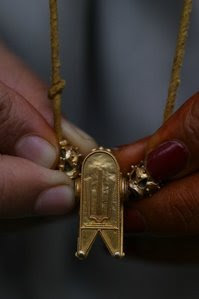
Madras…now called Chennai…is actually a city in the southern Indian state of Tamil Naidu. My husband’s nationality is South African, but his ethnic heritage is Indian…Tamil, to be precise. It may surprise you to know that more than a million people of Indian origin live in South Africa…Durban, in fact, is the largest settlement of Indian people in the world, outside India! And with that many Indian people living in the same community, many of the traditions of their homeland have remained intact.
Hubby and I were married nearly five years ago by a non-denominational minister in California. The thinking was this: the American government can be unpredictable about accepting such things as marriage certificates between an American and a foreigner if the marriage is performed outside the country. Furthermore, the US Immigration service might frown on a marriage between a 56 year-old American woman and a 31-year-old foreign man: they seem to think any foreigner marrying an American only has a “green card” in mind, and given the age difference, we decided to minimize the number of possible objections to the legitimacy of the marriage (foreign wedding) by getting married in the US. It’s rather moot, considering we live in South Africa, but if we ever want to return to the US and live as a married couple there, his ability to get a green card must be preserved.
The upside of getting married in California was that my friends and family could attend. The downside was that his friends and family could not…and the traditions of his culture could not be adhered to, either.
Well, our fifth anniversary is coming up in November and that is about to be rectified. His mother has consulted a Brahmin and the actual day of our anniversary has been pronounced an “auspicious day.” This is good, because one must perform important rituals on auspicious days, and the sentimentalist in me wants a ceremony officiating our marriage in his traditions to be on the same day as our marriage was performed in my traditions. So, on the eighth of November this year, we are going to the temple and we will participate in the “tying of the thaali.”
“Thaali” is a Tamil word and the thaali is the symbol of marriage in the Tamil (and many other) culture. The tying of the thaali is the most important ceremony in an Indian wedding, similar to our custom of exchanging rings. An Indian woman takes the thaali to be the most esteemed token of love offered to her by her husband.
Legend has it that the thaali was originally a tigers claw or tooth, and if you look at the thaali in the picture above, you can see the stylized tooth shape. The groom gifted his bride with this token of his bravery (apparently he was supposed to have killed the tiger himself, quite a feat in the days before hunting rifles!) and as a symbol that he was brave enough and strong enough to protect and provide for her.
Hindu married women, often wear a necklace with a gold pendant...In South India, the necklaces are often made from a colourful cord. The shape, size and number of gold pendant(s) used are rather dependant on the cultural background of the wearer.
To an Indian woman, this is rather like wearing the wedding band, it is a bit longer and heavier than the gold wedding band, but it serves the same purpose - an overt signal to all around, that the lady is spoken for.
The necklace is invariably given by the groom to the bride at a key stage during the wedding. It is his way of saying, “You are as precious as this gold to me” and his way of showing that he values her above all else.
It is called mangal sutra [in North India], because it represents “auspiciousness”. By wearing it, a woman announces that she is happy and fulfilled in her life, this is what makes her “auspicious”. The sutra represents the many strands of emotions, love, faith, trust, friendship etc that go into making up a relationship, especially one that is suppose to last a life time. It also represents the many relationships that bind them now, those of the two families that are now woven into one.
http://www.geocities.com/Athens/7830/mangalsutra.htm
In my husband’s family, the thaali is worn on a thick yellow cord, and it is kept beneath the clothing rather than displayed like a necklace or fashion accessory. It is also a custom made article…one cannot walk into an Indian jewellery store and say “Let me see your thaalis,” because it doesn’t work that way.
In my husband’s family the tradition is that a senior member of the family must order the thaali (I am guessing that this signifies acceptance/approval of the marriage by his elders). Each family has its own distinct thaali design, and apparently certain jewellers make thaalis for certain families and they know what the design is supposed to look like. Since we are already married, the whole Indian wedding thing can be dispensed with (to Hubby’s great relief), but I will still have to enter the temple barefoot and in a sari…Hubby has requested that I wear my wedding sari from our marriage in California. With a small number of family members present, the priest will direct him to tie the thaali around my neck and then give us his blessing. We will then be officially married in the eyes of the Hindu community.
Why is this important? Well, at least one of his relatives asks me “Do you have a thaali?” or “where’s your thaali” almost every time we visit. Although the thaali is worn inside the clothing, the thick yellow cord is visible, so if you aren’t wearing one, it is obvious. My husband respects the traditions of his family (and may be a bit intimidated by those formidable aunties of his!) and I would like to feel that we have honoured both his traditions and mine.
So, in November we are off to Durban for our anniversary and this year the gift will be one of tradition and great meaning.


