Sunday, January 08, 2006

There were beautiful plants, too...

So far, I've pretty much focussed on the animal life and our adventures on holiday, but there were beautiful plants everywhere, from formal, well-tended rose gardens to roadside wildflowers to delicately-leafed acacia trees sporting vicious-looking 3-inch long thorns. And the skies! There is nothing to compare with the intensity of the blue of the South African sky, especially when dotted with a flotilla of surreal-looking clouds. The Karoo boasts the most spectacular skies I have ever had the privilege to observe.
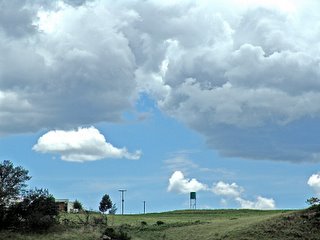

A sudden Midlands thunderstorm, however, brings its own spectacular sky.

La Provence in Colesberg, where we spent our first night on the road, had some pretty roses in the front garden...


But Tamakwa Country Lodge in the Midlands (http://www.tamakwa.co.za/) had a lush, lovely rose garden at the entrance.
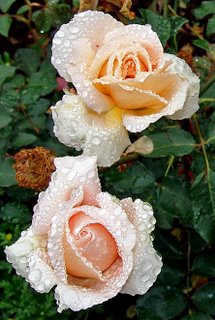
Each Sunday Tamakwa offers a decadent high tea and on an overcast early afternoon we stopped in to sample their offerings...lovely!
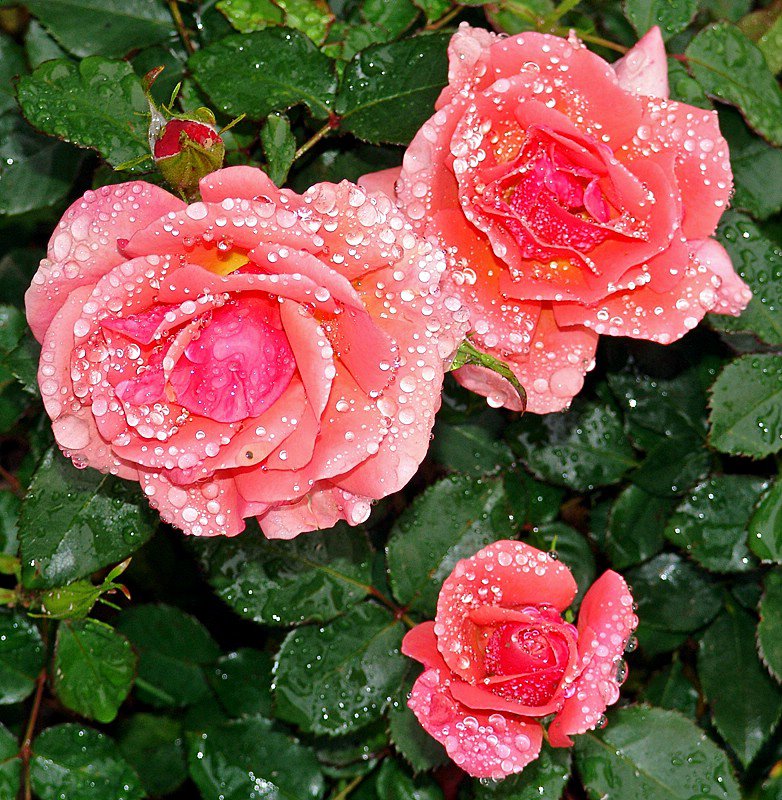

When we stepped back out, after stuffing ourselves with strawberry jam tarts and caramel custard, we found the roses fairly glittering with the results of a gentle rain shower.
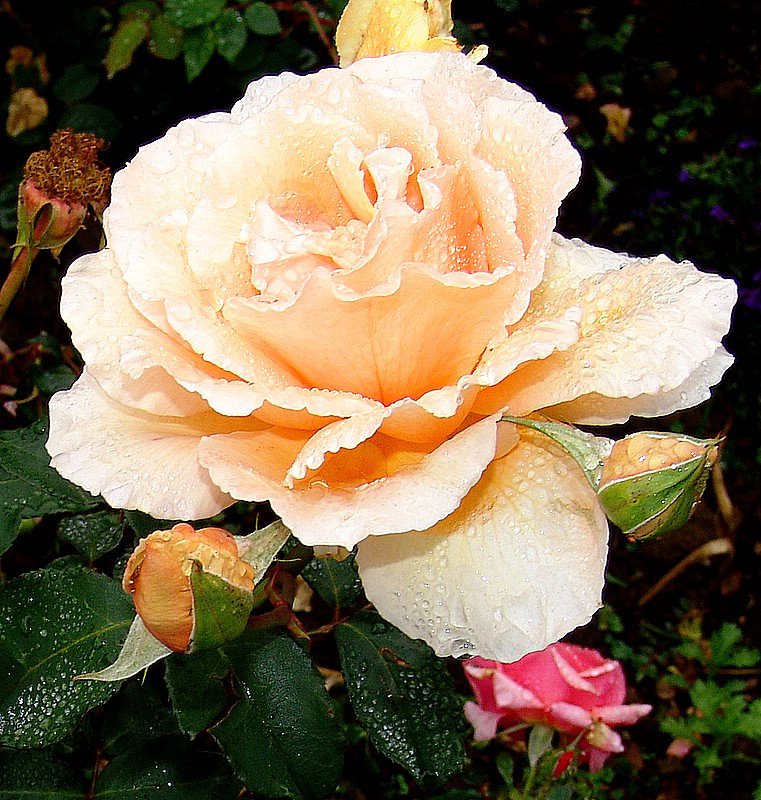
While Hubby got the car, I spent a little time with the camera, taking advantage of this rare opportunity.
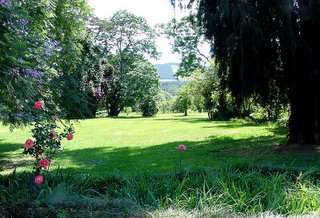
Fern Hill, our hotel in the Midlands, had a beautiful park-like setting. This was the view from the window of our room.

From the tea garden at Fern Hill we could watch the birds flit through this tranquil water feature.
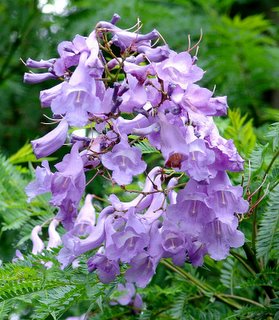

In America we call this a Blue Gum Tree, but in South Africa it is known as a Jacaranda. Fern Hill had an abundance of these delicately-leaved lavender-blossomed beauties.


These papyrus guard the entrance to the Jacaranda Tea Garden at the Fern Hill Hotel. They are the tallest papyrus...more than 12 feet (4 metres) tall...I have ever seen!


In the Midlands town of Howick, at the end of a narrow walkway bordered by little craft shops, we found this sweet little oasis.


Big Bertha earned her stripes...and a new nickname, "Dirty Bertie,"...on roads like this one. In fact, this was one of the better ones. The greenery in the Midlands was lush and thick at every turn.


Flowers grow wild along the side of the roads, the tar roads as well as the dirt roads. Here is a heap of roses growing on a fence along a main road.


Sunflowers found growing beside a railway bridge abutment
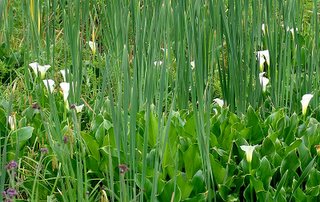

Even calla (arum) lilies grow wild in little swales by the side of the road.


And there is the bouganvillea...
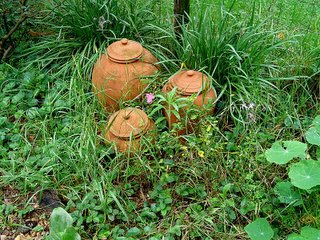

The grounds of the Dargle Valley Pottery were one of the greenest, lushest sites we visited...and it was down one of the darkest, narrowest, most poorly marked roads we encountered!


A field of yellow blooms at the Lion's River Trading Post.


We found a dense copse of blue hydrangea at Mill Cottage in the Midlands.


And an even thicker copse of hydrangea at the Fort Nottingham historical site,...which is way out in the countryside on a really rocky dirt road...outside a quaint little half-timbered building sporting an engraved brass plate identifying it as the consulate of Madagascar!


There are many marshy spots in the Midlands, and dams (ponds, to Americans) are in abundance. Here a little Red Bishop perches on a reed, guarding his nest.


Outside our room in St. Lucia there was this huge tree, a vlamboom (flame tree) thick with blazing red blooms.
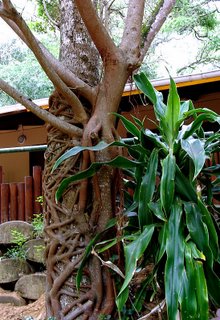

Outside the little convenience store in Cape Vidal we discovered this pair of trees, one wrapped completely around the other via these tendrils. The host tree did not appear to be suffering from its partner's embrace.


I've seen a lot of acacia trees since I've been here...they are very common...but these blooms are the first of this kind I have ever seen.


South Africans are familiar with the thorny acacia trees, but I had never seen one like this until my first visit to South Africa. These thorns are long, vicious and really, really sharp.

Isn't this a stunningly beautiful country?

Saturday, January 07, 2006

Goodbye to St. Lucia


There were no places to buy food in the game reserve so we had to head back to St. Lucia, an hour's drive, so Dear Hubby could have lunch...skipping a meal is simply not acceptable when you are diabetic. En route back to the Nyalazi Gate, entrance to the reserve, we found ourselves cresting a hill and seeing two vehicles pulled to the side of the road at the base of the hill. Obviously they were observing something, so we approached slowly, on the alert. Just as we pulled level with the other cars I spotted a small group of elephants clustered under some trees. Hubby pulled the car to a stop as I put the window down and stuck the camera out the window. Unfortunately, as I did so, this guy swung his head in our direction and began to fidget his front feet and bob his head. With Gavin's story about the park employees killed by elephant still fresh in my mind and this guy starting to advance on the car, I hurriedly snapped this shot and Hubby got us quickly away.

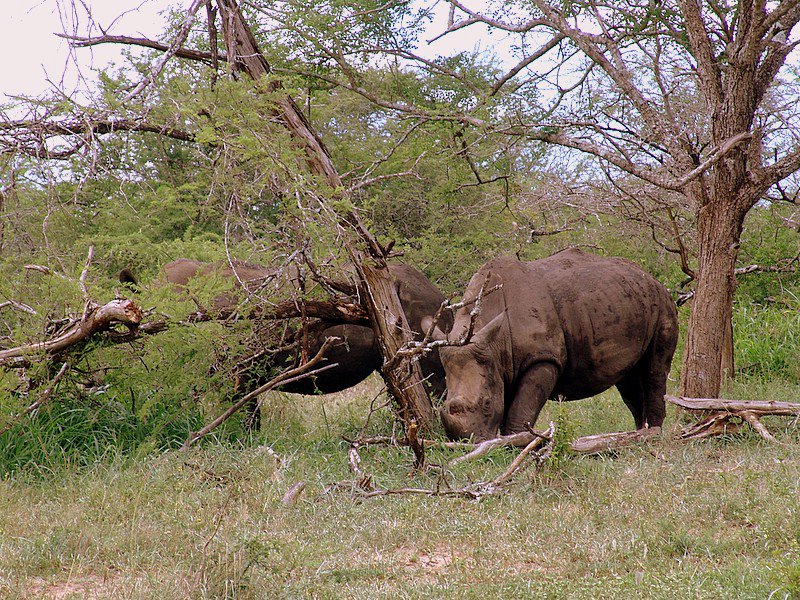
We came across several groups of rhino, this one being the closest to the road. For some strange reason, none of the pictures we got of any of the rhino showed their upper lips, so we were unable to determine if they were white rhino or black. Before this trip I had expected that we would find the rhino dangerous and the elephants calm...surprising that I found it to be just the opposite, the rhino quietly grazing by the side of the road but the elephant threatening.

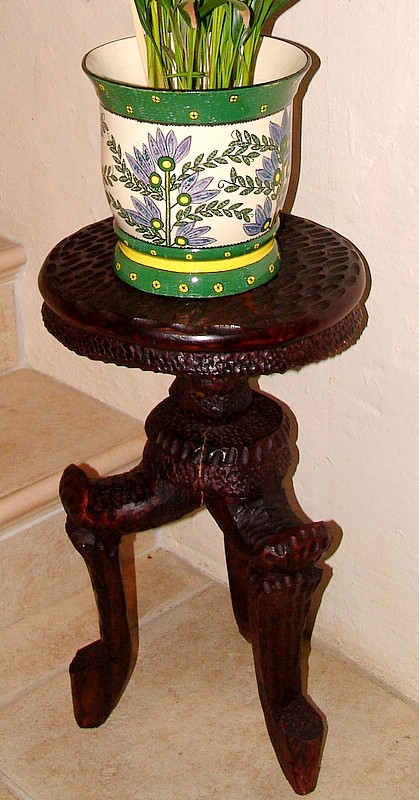
We returned to St. Lucia and grabbed lunch, then headed for the local open-air market, located in a huge boma beneath the most beautiful vlamboom (flame tree). Beneath the shade of the boma were the fresh fruit and veg vendors, their tables a colourful mélange of pineapples and mangoes, pawpaws and bananas, tomatoes bursting with ripe freshness. In front of the boma, under the spreading branches of the vlamboom, were the curio sellers. Woven grass beach mats, hats and tote bags, hand carved representations of local birds and other wildlife, lengths of hand-dyed fabric, rag rugs, and at one end of the line up, a stunning hand-hewn three legged table.

We had had lunch the previous day in a restaurant called Für Elize, a place that seemed to specialize in crocodile dishes. While awaiting our meal (fast, efficient service not being one of the hallmarks of this establishment in particular and St. Lucia in general), I studied the structure of the boma in which the restaurant was located and the décor, most of which was of local origin. It was here that I saw one of these tables, a charming blend of European lines and African originality. Unfortunately, none of the curio stands we saw during our travels exhibited such a table, but on this particular visit to the open air market, we spotted one and, after a bit of negotiating (Hubby is a great haggler!) the table was mine for only R150! ($25). It now sits in my hallway, supporting my Ardmore pot...which we picked up at the Ardmore pottery in the Midlands...and a frothy little house palm.

The morning we left St. Lucia the temperature was 30C as we loaded the car. We were on the road back to Durban by 9 am, retracing our steps through the sugar estates, our first leg of the long journey home.

Friday, January 06, 2006

Dirty Bertie earns her name...

We had dinner on Saturday evening at Alfredo’s, an Italian restaurant located in a complex of small apartments, and sat outside near the pool. Cuisine is not a priority in St. Lucia, which undoubtedly explains the presence and popularity of the Ocean Basket, but Alfredo’s did a passable pasta. While sitting outside we were visited by a rather friendly cat and when Hubby inquired if it was the restaurant’s cat, the server replied “Oh, no…this is St. Lucia’s cat!” Rather than find feral cats a scourge, as we seem to do in America, the town of St. Lucia has adopted these homeless cats, allowing them to roam freely through the outdoor restaurants and holiday accommodations. We met at least five cats during our stay, all of whom were friendly communal cats, well fed, friendly, and a delight to the tourists.

Gavin had suggested that we go to Imfolzi or Hluhluwe, game reserves across the highway from St. Lucia, if we wanted to see elephants and rhino, their local brethren having been rather shy with us. So, early the next morning we rose to a breakfast of pineapple and orange juice, loaded up Bertha…which had acquired the nickname “Dirty Bertie” by this time…with cold drinks and snacks, and headed for Hluhluwe (“shuh-SHLU-wee”).

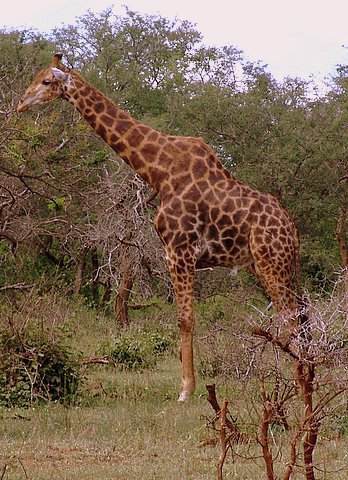
As it turned out, Gavin had given us an excellent suggestion. Almost immediately upon entering the park, we met up with a giraffe having an early breakfast. Ignoring us as if we were not even there, he browsed the top of a stickery acacia tree, calmly chewing and looking as if he hadn't a care in the world. I've seen giraffe in zoos...the San Diego Zoo is one of the finest in the world and I have been there more times than I can remember...but nothing prepared me for seeing this long-necked giant nonchalantly chewing the top off a tree from the side of a road! Encountering him had been quite a surprise ad we had not expected to find wildlife within minutes of entering the reserve, but we drove around a curve in the road and there he was!

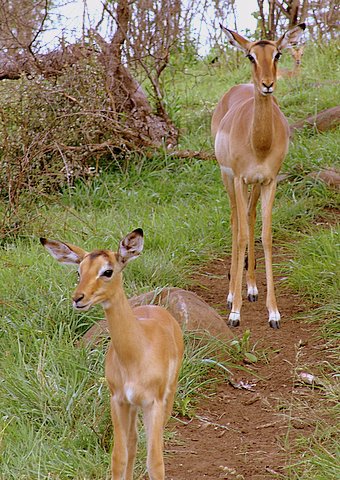
At the entrance gate, when he paid our fees, Hubby bought a map book that turned out to be invaluable. Not only did it show the various roads and view spots in the park, the back of the book contained excellent drawings of the resident animals, enabling us to identify many of the creatures we sighted. Impala...the antelope after which one of Chevrolet's most successful models was named...are tiny little creatures! I had expected a larger, bolder, more impressive looking animal, so the slightness and delicacy of their body structures really surprised me. They are reputed to be shy animals, but the were the single most common species we encountered and while I wouldn't call them exactly friendly, they were not easily spooked. We came across this cautious mother and curious baby as part of a larger herd.

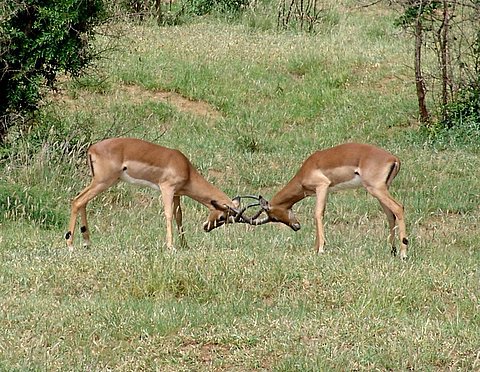
The juvenile bucks engage in mock battles, practicing for the day they will challenge other bucks for mating rights. We drove over series of hard-packed dirt roads, watching for game and, cresting the top of a hill, we spotted a herd of perhaps fifty impala spread out across a rolling meadow. In one swale three pairs of young bucks were hard at work honing their fighting skills. Like the giraffe, they ignored our presence, not even stopping to look and assess whether or not we represented a threat. These youngsters do not yet have the distinctive horns of the impala buck, but the black patches on the ankles mark them definitively as impala.

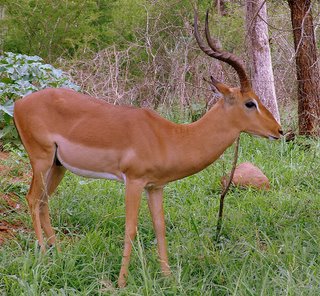
Adult impala males, small as they are, carry an impressive set of curved horns (or are they antlers?) This buck, tiny and delicate as he may appear, is an experienced fighter, else the herd of females, babies and young juvenile males we found him with would belong to a stronger male. Behind him in the grass is one of the ubiquitous termite mounds (no, it is not a rock)...a rather small one, actually. These mounds dot the landscape of South Africa like so many freckles.
Twenty kilometres beyond the entry gate, the tar road played out and the rest of our morning was spent on dirt roads in varying states of disrepair. We went through dry riverbeds, the roadway simply a path of hardened mud and bumped through ruts and over rock, thankful to have brought Bertha on this holiday...there was no way the Pretty Baby (Hubby's Honda S2000) would have made it through this! Five kilometres or so beyond the Mpilo camp (where the tar road ended) we came upon a view site, the most impressive sight being this warning sign at the head of a hiking trail. I started wondering what kind of people came down here to holiday...water skiing in crocodile-infested waters, hiking on trails where you are likely to encounter lion, hyena, leopard, buffalo, rhino and elephant...not to mention the poisonous snakes and the fierce South African sun...are they certifiable or what?

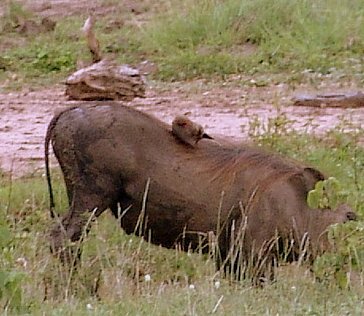
Our first warthog sighting was disappointing...the animals were in thickets the camera could not penetrate and when they broke out into the open, they were moving too erratically and swiftly to get good pictures. The tar road had long given way to dirt, but now we were encountering "loops"...lesser-travelled dirt tracks that looped back onto the main road. Hubby turned Bertha onto the Sontuli Loop and things began to liven up. One of our first encounters was a small family group of warthogs, one of which had a bird riding on its back. Warthogs often have symbiotic relationships with small birds that keep their skin free of ectoparasites such as lice and ticks, and this one simply rode the warthog much like I might sit a docile, well-trained horse.

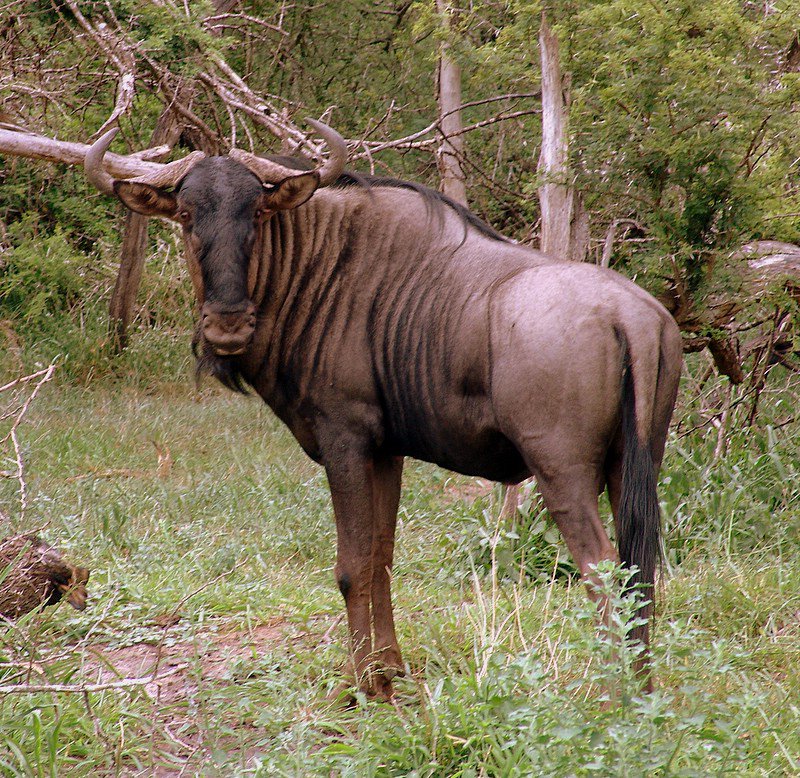
On our drive with Gavin we spotted a couple of wildebeeste (gnu) under a tree, but they were too far away to photograph. He told us that they were...well...not the rocket scientists of the veld. I don't know how accurate he was, but you have to admit that the face does convey an impression of dullness. He stood and watched us for a few minutes, moving forward and back a bit as if unable to decide whether he should come investigate the car or flee. Despite its size, the wildebeest is not known to be an especially aggressive animal, so we simply observed him until he eventually just ambled away, apparently unimpressed with and unalarmed by either us or Bertha.

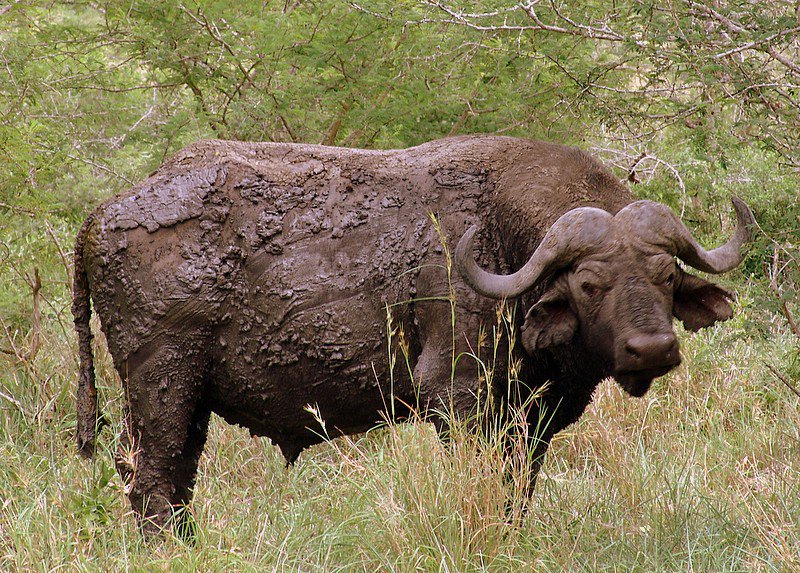
Buffalo, however, are dangerous, hostile, stubborn animals. Gavin told us of an incident at a game reserve where he used work in which a person was killed by a buffalo bull. The animal, wanting to be sure the person was dead, stood over the body, occasionally assaulting it, for three days before being sufficiently certain of the man's death to move on. This bull didn't look exactly pleased with our presence, so we made ourselves scarce after snapping only this one shot. Often these animals have bird passengers as well, but if I was a bird, I think this guy's mug would definitely put me off!

Unfortunately, there were no restaurants or snack shops in the reserve and so after taking two of the loops and finding an abundance and variety of animals beyond our expectations, we had to head back to civilization...lunchtime was approaching and Dear Hubby is diabetic and skipping a meal is not an option. But as much as loop roads had revealed that variety and abundance of wildlife, it was not until we were on our way back to town that we finally got an up-close-and-personal look at the beasties we were specifically hoping to see...the rhino and elephant.

Next entry, you'll see them too.

Wednesday, January 04, 2006

It was a steamy, sultry morning, too…

St. Lucia was hot and humid…30C before nine in the morning…and, ironically, you had to keep moving to keep cool. Sitting still only allowed you to stew in your own juices. We had an appointment at eight to meet a guide and a Toyota 4x4 bakkie (pickup) that had been converted into a game drive vehicle. To our great delight, nobody else in town was eager to get out of bed early on a Sunday morning, so we had the truck…and Gavin, the guide…all to ourselves. We clambered up the diamond-plate steps that had been riveted to the vehicle and took our seats under the canvas canopy, eager to be off. Even without the promise of the animals, we needed to be moving as the air was still and I could feel a sticky sheen of sweat forming all over my body.

The Wetlands park is as wild and unspoiled place as you are likely to find anywhere and the entrance gate was but two blocks from our hotel (which was located smack in the middle of St. Lucia!). Our guided game drive got off to an auspicious start...within minutes of entering the park we began seeing animals. It was birds and little red duiker...a member of the antelope species no bigger than a German Shepherd...at first, but as we went deeper into the park, more creatures emerged.

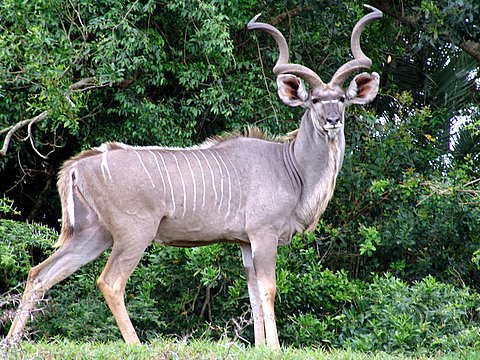
At first it was mostly birds. We spotted a bird that looked remarkably like a small bald eagle which our guide told us was a Wahlberg's eagle and a very rare banded snake eagle sitting nonchalantly atop a telephone pole. Shy red duiker ducked into the roadside bushes and a handful of diminutive reed buck crossed the road in front of us on delicate little hooves. And then we rounded a curve and, on Hubby's side of the truck, we spotted this stunning kudu buck. He stood, frozen in his magnificence, looking straight into the camera as Hubby snapped and snapped and snapped again.

When he finally turned to leave, he did it in an unhurried, nonchalant manner, as if our presence was merely a curiosity of which he had finally gotten his fill. Gavin, our guide, had worked in one of the more remote game parks until recently and had a wealth of information about South African wildlife. Unlike America, in South Africa you can buy game meats in the supermarket and Gavin explained that herds are culled to keep their populations from growing beyond the ability of the game reserves' vegetation to support them, and when an animal such as this has reached an age that he is no longer able to live healthily, they are put down, their meat, hide and horns sold into the commercial market, and the proceeds going back to the game park to help preserve habitat. Seemed like a practical approach on the one hand, but my heart shrunk at the thought of killing such a magnificent beast for reasons beyond survival.

We took off on what Gavin called the Loop Road, a mostly dirt track through some pretty densely forested land which eventually emerged onto a broad grassy flood plain. Here we saw a herd if zebra, there we saw a reluctant rhino which, with her baby, disappeared quickly behind a hillock at the sound of our approaching vehicle. More antelope, our first warthog sighting, several troupes of baboons...which seemed to melt into the underbrush the moment a camera was pointed their way, and vervet monkeys, those cute little creatures that plague households in Durban with their unwelcome...and destructive...visits. You've never seen anything cuter than a baby vervet monkey, with it's pale wrinkly face, sparse coat and jug ears...they look almost human!

We asked Gavin about other animals in the park and he told us that elephant had been moved onto the site but suggested we might better see elephant at Hluhluwe, a game reserve about 50 km away, on the other side of the N2. He wasn't keen on viewing the St. Lucia elephants, telling us that only a month ago two park employees, a man and a woman, had been killed by the elephants while still inside their vehicle! The elephant crushed the cab of their truck, goring the woman and killing her instantly, and then it grabbed the man and flung him into the bush. He died three days later of his injuries.

Hubby asked if there had been any incidents involving boat passengers and hippos and I lamented our failure to see crocodiles on our boating expedition the day before...we saw only one croc and he was so far away he showed up in the photo as a serrated log floating a metre or two off a pod of hippo. In response, Gavin promised to take us to a prime croc-viewing site once we were back in town. I looked at Hubby with raised eyebrows...in town? As we finished the loop and headed back to town, Gavin regaled us with tales of St. Lucia's wildlife...the leopard he saw crossing the main street of town late one night, the hippos that come out at night to feed on local gardens, and the annual killing of local residents and tourists by crocodile..."It happens every year," he told us. "There's already been one this season..."

Back on the tar road, we headed into town. St. Lucia is a small place, the main street being no more than four blocks long (but it has a Spar, a Wimpy, an Ocean Basket and three internet cafes!). At the other end of town Gavin veered left into a thickly shaded roadway, telling us the best vantage point for viewing crocodiles was down this road, at the Ski Boat Club. It took a minute to register...ski boats? As in water skiing? In crocodile-infested waters? No wonder the crocs kill people here every year! And no wonder they bask on the sandbar across from the boat launch...they must think of this place as a first rate dining spot, with the entrees serving themselves! This photo was taken from the Ski Boat Club, about 20 metres from the boat launch, so you can see just how close these things get. Would you go water skiing with this guy and a dozen of his buddies hanging out, just waiting for you to go near the water?

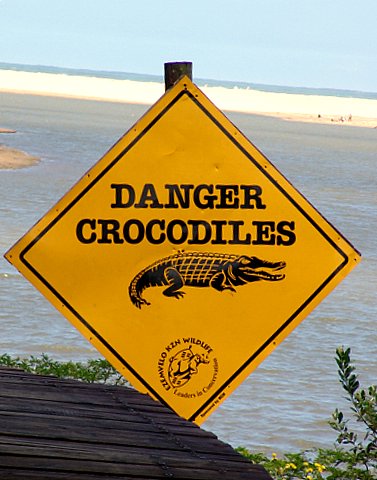
All joking aside, crocs taking people actually is a problem around here, and to my great surprise, it is not just stupid tourists who end up crocodile lunch. In March of 2005 a St.Lucia resident, a fisherman, was taken by a crocodile. His remains (what was recovered of him) were cremated and his ashes scattered near the spot where he was taken...which, as near as I could tell from the news reports, was near where this crocodile picture was taken. Of such a magnitude is the problem, warning signs like this one are posted at the entrances to the beaches near the Ski Boat Club. Gavin told us that crocodiles are one of only three species that view man as prey and will intentionally hunt us for food, the other two being polar bears and tigers. And people go water skiing right in front of them...

But some doors swing both ways...

Next entry...warthogs and rhinos and elephants...oh my!

It was a sultry, sweltering night...

We left Durban on Saturday morning, the 10th of December, and headed straight for St. Lucia, a World Heritage Site located on the shores of the Indian Ocean halfway between Durban and Swaziland (http://whc.unesco.org/pg.cfm?cid=31&id_site=914) . To say it was hot and humid would be an understatement of immense magnitude…Durban was hot and humid: St.Lucia was sultry and sweltering…and lush, and green and tropical.

The three hour drive to St. Lucia took us through miles and miles of sugar estates (sugar cane farms). Waves of rolling hills covered with the tall cane grass rippled with the shifting winds, clusters of trees and farmhouses standing out like so many oases in a desert of green. We passed the hulking red heaps of the sand mines at Richard’s Bay, and soon found ourselves on a narrow paved road with wide green verges cut through the middle of a eucalyptus paper forest…a forest planted by one of the local paper companies. We emerged at a bridge from which we could see a dock and a tour boat and at the other side of the bridge we found the little town of St. Lucia.

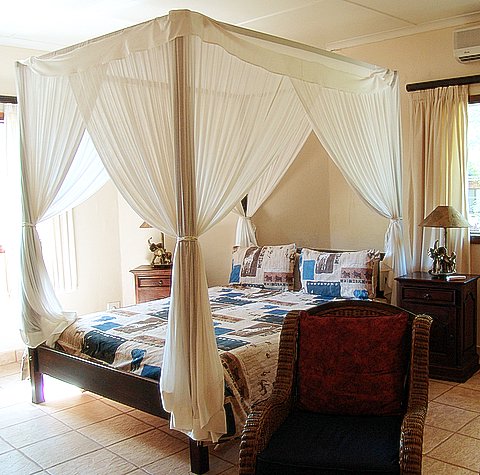
The air conditioning in the car and our hotel room provided welcome respite from the heat, but, surprisingly, it wasn’t as bad as I expected (I don’t handle humidity all that well). As long as there was a breeze, it was tolerable and so we set about to explore our environment. The room was lovely, with a fully functional mosquito net, designed as a decorative curtained canopy, draped over the bed. Fortunately, with the aircon, we didn't need it...we just closed up the windows and turned on the cool air. After settling into our hotel, the "Hippo Hideaway," we headed back to that bridge, camera in hand, and took an afternoon boat ride on the St. Lucia Estuary.

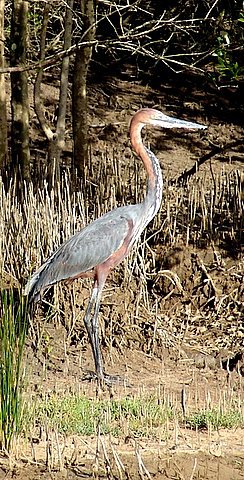
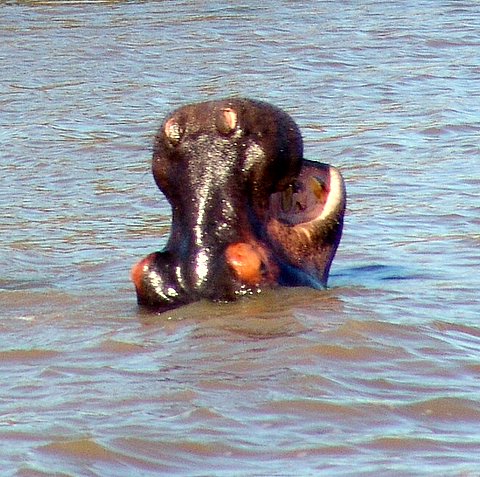
I like birds. Since I am allergic to the lovely creatures, however, I can’t keep a pet bird, so I must content myself with viewing the wild ones, many of which visit our large back garden at home. Hubby, bless his heart, is mostly bored with my bird-prattle, but knowing how much I enjoy looking at the creatures, booked St. Lucia because he had heard there was abundant birdlife there…and he heard right. The cruise up the Estuary showed us Egyptian geese and Goliath heron (a fairly rare bird, shown at right), white egrets and cranes, any number of stilt-legged shore birds probing the muddy beaches with their needle-like beaks. We watched a pied kingfisher hover and dart for its food and observed the majestic African Fish Eagle, a dead ringer for the American Bald Eagle, roosting high in the branches of a waterside tree. But the cluster of rocks we saw in the distance, something dismissed originally as uninteresting lumps of stone, turned out to be one of the highlights of the trip: a pod of hippo!

Sheep cluster in flocks, cattle and horses in herds, geese in gaggles…and hippos cluster in pods, like whales. We learned that because hippo young are born under water and suckle under water, like the young of such marine mammals as whales and dolphins, their groups are called pods as well. You cannot imagine how big these things are until you actually see one up close and personal. I’ve seen many of these things in the zoo and believe me, it’s just not the same. They can appear and disappear from the water in a silent instant, leaving not even a ripple in the choppy estuary waters to mark their presence. For such immense animals, they are eerily silent in their movements, although their vocalizations sound surprisingly like a man’s snores! Hippos are vegetarians and they emerge at night, when there is no sun to burn their skin, to browse on shore. “Beware of Hippo” signs abound!

"Hippopotamus" means "river horse" (in Greek, I think) and in Afrikaans they are called "seekoei," or "sea cow." It is difficult to imagine why on first glance, since they appear to be bulky, lumbering and slow, but we were told that despite their bulk, they can run at respectably frightening speeds on land and that they do not swim in the rivers and estuaries, but "run" in the water. If you have ever tried running with most of your body submerged and experienced the substantial resistance water provides, you will have some insight into the swiftness of this animal on land...if it can successfully run in the resistant water, imagine what it can do in virtually unresisting air!

The weather in St. Lucia is nothing if not unpredictable. Heat and humidity are a given, but like Hawaii, if there is even a hint of a breeze, it's just not that bad. But we arrived in St. Lucia in the early afternoon to clear blue skies and daunting sunlight, only to find ourselves racing a storm back to the boat launch site. In a matter of just a few hours the day had gone from the South African sun beating down on us to threatening rain...a threat that was realized just as we sat down to dinner...outside, of course. After fiddling with the camera a bit, I was able to get a picture of one of the storm clouds as it turned our sunny boat ride cool and dark.

We returned to our hotel room after stopping at an outdoor market to buy pineapples. My mother-in-law had asked that we bring back a few for her and, since Hubby and I both love pineapple, we picked up a few for ourselves. After a night in the fridge, they provided a cool, refreshing breakfast for us the next morning as we headed out on our next adventure: a guided tour of the Cape Vidal wilderness area aboard one of those safari trucks.

Next entry: safari truck, kudu, and those man-eating crocodiles.

Tuesday, January 03, 2006

I went on holiday...


So, Hubby and I went on holiday and boy! did we have a good time! Big Bertha, our Mercedes ML, made the 1800 kilometre drive to our destination in air conditioned comfort...and, to our great pleasure, acquitted herself extremely well on the hundreds of kilometres of rutted dirt roads we encountered once we arrived.

The Natal Midlands is a slice of lush temperate rainforest dropped smack in the middle of KwaZulu Natal, and it is one of South Africa's most beautiful hidden gems. Driving south from Johannesburg along the N3, you see only the barest hints of the treasures lurking behind the thickets that line the highway. Once off the highway, I was hard pressed to remember we were not rambling along the verdant country roads of my native Oregon.

We booked into the Fern Hill Hotel at Tweedie, intent on doing the Midlands Meander. Five days later…and an alarming number of rands lighter…we checked out and headed for Durban and my mother-in-law’s surprise 60th birthday party.

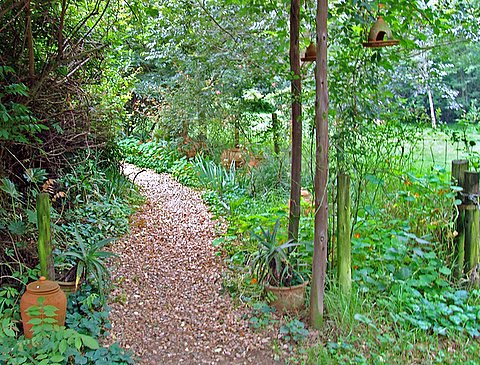
The Midlands Meander is a network of crafters and artisans, shops and accommodations, located in the Midlands off the original twisting, winding road between Johannesburg and Durban. More than half of the shops that dot the area are on unpaved roads, many of them deeply rutted, badly marked, sharply curved, and quite a few at alarmingly steep elevations….just the kinds of roads we bought Bertha to navigate. Weavers, cheese makers, potteries…the first photo was taken at Dargle Valley Pottery in the Midlands…sculptors, glass shops, antique shops, quaint B&Bs…and kilometre after kilometre of the most gorgeous scenery you could ask for.


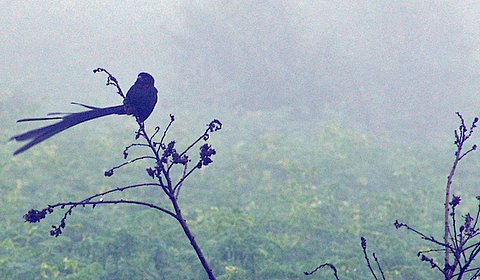
En route to Shuttleworth Weaving, located well off the beaten track at the end of a long, deeply rutted road, we came across this widowbird. He flew across in front of us, long tail floating in the breeze behind him like a ribbon, and perched delicately on this stalk. A thick morning mist clung tenaciously to the hillside, giving a kind of soft glow to the landscape. It was quite beautiful.


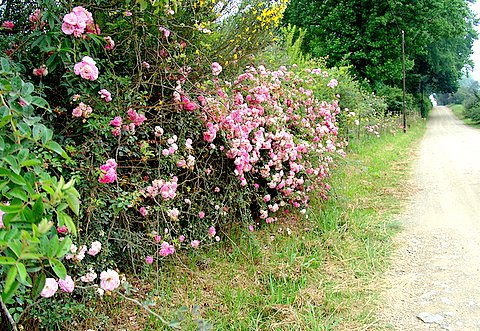
Roses grow wild by the side of the road in the Midlands. This is but one of the thickets of wild pink roses that grew in heaps along side the roadways. Sunflowers also grow wild along the verges, their golden faces turning with the sun as it moves across the sky.


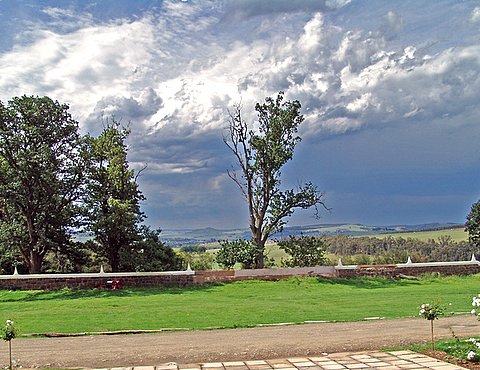
Greenfield is an immense farm…a ranch by American standards…where they raise beef cattle. But that’s not all…Greenfield also boasts a B&B, a butchery (which is open to the public), a restaurant (the absolutely best food we had in the Midlands!) and this glorious old stable which has been converted into a linen shop…and at fabulously discounted prices, too! This building was put up in 1893 and is even more magnificent than this picture can show. Last is a picture of the Mooi River Valley taken from the steps of Greenfield. A beautiful place, don’t you think?

After leaving the Midlands we cruised on down to Durban where we celebrated my mother-in-law's 60th birthday. Amazingly, despite the fact that there were more than 60 confirmed guests, we managed to keep the whole thing a secret! After a night in Durban, we were on the road again, this time headed for St. Lucia ( http://www.stlucia.org.za/ ) where we met up with angry elephant, man-eating crocodiles, and the most delicious pineapples this side of Hawaii…which are, of course, the topic of my next entry.