
Puddin' is a good example of her breed, considering that she is not quite 6 months old. She's cute, spunky, intelligent, and cheeky...a true terrier. I've taken regular pictures of her in the months I've had her, and share some of them with you now:


Showing posts with label photos. Show all posts
Showing posts with label photos. Show all posts
Saturday, June 20, 2009
Yorkie pictures

Wednesday, January 02, 2008
Have you ever seen anything more spectacular?

This is one of the plants growing at the Goble Palms Guest House in Durban. I've never seen anything like it before, and it took a lot of Googling to finally track it down.
The plant is called "medinilla magnifica" or "rose grape" and this stunning flower is about 10 inches long. A native of the Philippines, it can be an invasive plant since each flower ripens into a berry that, once dropped to earth, will become a new plant. It is, however, a breathtakingly beautiful flower.
See more of my photos at http://www.flickr.com/photos/sweetviolet/
Sunday, November 25, 2007


Thursday, January 11, 2007
Sweet (African) Violet
My mother wasn’t particularly domestically-inclined so I learned many of the womanly arts from my grandmothers. As a result of their patient instruction, I can cook, bake, clean, launder, mend, and can do a credible job of most common forms of needlework. I can even keep a vegetable garden (and preserve its produce), and do a fair-to-middling job of keeping some nice houseplants. But, despite my moniker, I’ve never been able to grow African Violets.
Now this is kind of an embarrassing admission, considering that one of my grandmothers was actually named Violet and the other one collected Occupied Japan porcelain in the “Sweet Violets” motif…and grew African Violets by the hundred. It’s not that I don’t understand their basic needs…filtered light, “wet feet,” and no water on the leaves…it’s just that once their original hothouse blooms have faded, I am left with a shelf full of identical pots full of identical flat hairy leaves. They never, ever bloom again.
Oh, I’ve probably tried all of the tricks and remedies you can think of…changing the watering schedule…“African violet food” in liquid, sticks, and tablets…soil specifically formulated for African violets…changing the light exposure…nothing helped. Eventually, getting no reward (blooms) from the plants for all my ministrations, I would begin to neglect them and one day sadly find their dried and shrivelled corpses where once fat hairy green leaves had flourished.
After several fruitless forays into African violet cultivation, I pretty much gave up and bought fake ones for the pretty pots, but still, they beckoned me. In the supermarket thick emerald leaves crowned with a topknot of beautiful blooms called to me. A beautiful white…a frilled white with lavender edges…a robust traditional violet…”Buy me!” they called out “Only R14! ($2)” “Take me home!”
Seductive little buggers that they are, I am soon hopelessly plunking three new African Violet plants in the bathroom…actually, our toilet is in a separate room of its own, with a tall opaque window, and I put them in there. The shelf over the commode is just the right width for three of them, but within a few days some of the larger leaf stems are becoming soggy. Alarmed that they might actually die before even the hothouse blooms have finished, I move them to the window sill, careful to open it no more than an inch, lest the blazing Cape Town summer sun burn them to a cinder. Within days they have recovered (although I did lose those leaves) and their pretty little blooms liven up the tiny loo.
But all good things must come to an end, and eventually I found myself picking the shrivelled brown petals out of the leaves and resigning myself to three pretty plants on the window. They seemed to like the window, after all, with new leaves bursting out and the old ones growing thick and sturdy and crisp. When I would wash my hands I would check their saucers and refill them as necessary, taking comfort in the knowledge that even if they never blossom again, at least I am cultivating the healthiest crop of African violet leaves I’ve ever seen!
And then one morning, it happened. Looking up from the local gossip rag (we keep a rack of them in the loo), I thought I saw something suspiciously round nestled in the middle of one of the violets…not a new leaf, but something I hadn’t seen before. When I washed my hands I took a close look and, to my great amazement, saw buds! Buds! The plant was planning to bloom for me! But which one was it? After months of watering and moving them on the shelf according to who needed more light (based on leaf sturdiness and size), I had no idea which violet was about to burst forth into bloom!
Within a few days it became apparent that it was the white one and about the time it began blooming, the purple one started showing buds. And after a lag of a couple of weeks, the ruffled one began setting buds, ready to flower. I was amazed! Delighted! Enthralled! For the very first time in my life, my African violets were blooming for me!
Now this is kind of an embarrassing admission, considering that one of my grandmothers was actually named Violet and the other one collected Occupied Japan porcelain in the “Sweet Violets” motif…and grew African Violets by the hundred. It’s not that I don’t understand their basic needs…filtered light, “wet feet,” and no water on the leaves…it’s just that once their original hothouse blooms have faded, I am left with a shelf full of identical pots full of identical flat hairy leaves. They never, ever bloom again.
Oh, I’ve probably tried all of the tricks and remedies you can think of…changing the watering schedule…“African violet food” in liquid, sticks, and tablets…soil specifically formulated for African violets…changing the light exposure…nothing helped. Eventually, getting no reward (blooms) from the plants for all my ministrations, I would begin to neglect them and one day sadly find their dried and shrivelled corpses where once fat hairy green leaves had flourished.
After several fruitless forays into African violet cultivation, I pretty much gave up and bought fake ones for the pretty pots, but still, they beckoned me. In the supermarket thick emerald leaves crowned with a topknot of beautiful blooms called to me. A beautiful white…a frilled white with lavender edges…a robust traditional violet…”Buy me!” they called out “Only R14! ($2)” “Take me home!”
Seductive little buggers that they are, I am soon hopelessly plunking three new African Violet plants in the bathroom…actually, our toilet is in a separate room of its own, with a tall opaque window, and I put them in there. The shelf over the commode is just the right width for three of them, but within a few days some of the larger leaf stems are becoming soggy. Alarmed that they might actually die before even the hothouse blooms have finished, I move them to the window sill, careful to open it no more than an inch, lest the blazing Cape Town summer sun burn them to a cinder. Within days they have recovered (although I did lose those leaves) and their pretty little blooms liven up the tiny loo.
But all good things must come to an end, and eventually I found myself picking the shrivelled brown petals out of the leaves and resigning myself to three pretty plants on the window. They seemed to like the window, after all, with new leaves bursting out and the old ones growing thick and sturdy and crisp. When I would wash my hands I would check their saucers and refill them as necessary, taking comfort in the knowledge that even if they never blossom again, at least I am cultivating the healthiest crop of African violet leaves I’ve ever seen!
And then one morning, it happened. Looking up from the local gossip rag (we keep a rack of them in the loo), I thought I saw something suspiciously round nestled in the middle of one of the violets…not a new leaf, but something I hadn’t seen before. When I washed my hands I took a close look and, to my great amazement, saw buds! Buds! The plant was planning to bloom for me! But which one was it? After months of watering and moving them on the shelf according to who needed more light (based on leaf sturdiness and size), I had no idea which violet was about to burst forth into bloom!
Within a few days it became apparent that it was the white one and about the time it began blooming, the purple one started showing buds. And after a lag of a couple of weeks, the ruffled one began setting buds, ready to flower. I was amazed! Delighted! Enthralled! For the very first time in my life, my African violets were blooming for me!
 Seems all I needed to do to grow African violets was to move to Africa…
Friday, November 10, 2006
Home again, home again…
 The lavender farm in Franschhoek
Wednesday was our third wedding anniversary and to celebrate the occasion (as well as Hubby’s new job, which starts on Monday next), we took a few day's sojourn to the local wine country.
The village of Franschhoek is less than a two hour drive from Cape Town, but a world away. Joburgers, who think Cape Town is a laid-back, “hang loose” kind of place, must find Franschhoek to be standing still. But Franschhoek isn’t the quaint little village it likes to think of itself as being…oh no. It’s appeal is as studied and contrived as Disneyland’s Main Street, USA, for all that many buildings on the main road through town are truly masterpieces of the art of building preservation.
The village of Franschhoek is less than a two hour drive from Cape Town, but a world away. Joburgers, who think Cape Town is a laid-back, “hang loose” kind of place, must find Franschhoek to be standing still. But Franschhoek isn’t the quaint little village it likes to think of itself as being…oh no. It’s appeal is as studied and contrived as Disneyland’s Main Street, USA, for all that many buildings on the main road through town are truly masterpieces of the art of building preservation.
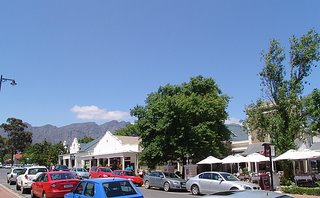 Franschhoek Village
This place is a village only in the sense that it is fairly small in size…but don’t look for the support services you would expect of your average farm village. I didn’t see a musty old hardware store or a farm equipment dealer or repair shop, no forge for mending unhappy implements, no drilling company or pump and irrigation sales…a village for the support of the neighbouring farms, Franschhoek definitely is not.
 An old house in the village
So what is it? The main street is lined with one well-preserved ancient Cape Dutch building after another, In most cases only the façade is fully intact, the rest of the building having been gutted to serve as home to a long queue of trendy restaurants that range from “just ordinary” to “truly superb” in quality. I’d like to say “with prices to match,” but our seven meals, unfortunately, lead me to believe that restaurants in Franschhoek range from eyebrow- raising to “quick, call the paramedics!” in price.
Hubby is a man who enjoys his creature comforts and when we take these little holidays they are usually short enough to allow us to afford four-and five-star eateries and accommodations. But sometimes you wonder why the stars were granted. The eponymous Reuben’s, known as not only the best restaurant in town, but the best in South Africa, deserves every one of the five stars in its crown. But don’t expect cuisine…fine or otherwise…from The French Connection, despite the recommendations and stars. Any restaurant that feels it must notify its patrons that it is a “bistro” and to therefore not expect greatness in the fare, should be approached with caution. We found the food…particularly the lamb and the French fries…overdone and the portions rather skimpy (a ham sandwich with one layer of nearly transparent ham?), and the woman at the table next to us sent her entrée back to the kitchen because her roasted kudu was refrigerator-cold. How many stars is that kind of gastronomic offering worth?
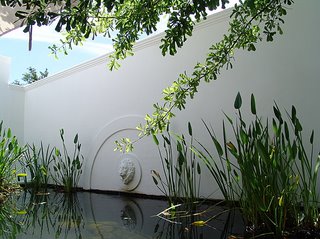 Pond at Bread & Wine Restaurant
Accommodations are likewise “luck of the draw,” the stars meaning considerably less than one might ordinarily expect. I expect a certain level of luxury and upmarket appointments in a four star accommodation…certainly a queen-sized (if not a king) bed, and definitely a real shower, certainly not a hand shower in the tub (and no shower curtain). I have long come to expect mosquitoes every place I go in South Africa…we don’t seem to have gotten the word about window screens yet…so checking the ceiling corners for mossies before turning in is a nightly ritual nowadays. But we didn’t sign up for an army of creepy little roommates! On our second night I was jolted awake by an overly friendly spider which Hubby then had to hunt down and slaughter, the third night I found a little slug merrily running laps around the inside of the bathtub rim, and every night a battalion of two-inch long centipedes marched across the bedroom carpet, defying both squishing with shoes and picking up with tissue…and refusing to die even after being heavily dosed with Doom. Ya know, to my mind, the fact that the proprietors of this establishment thought it prudent to supply our suite with a can of Doom says volumes all by itself.
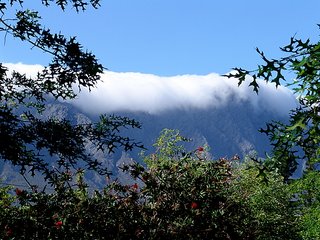
View of Franschhoek Mountains from Lavande
All negatives aside, though, the Franschhoek Valley is as beautiful a place you could ever hope to see. The craggy, majestic mountains encircling the fertile river valley, kilometre after kilometre of lush green vineyards and silvery-sprigged lavender fields, rustic thatched-and-whitewashed homes…it’s as delightful to the eye as the wines are to the palate.
 Boekenhoutskloof Winery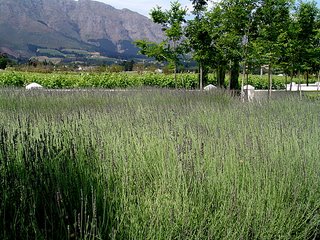
Lavender fields at Grande Provence Winery
It was an enjoyable few days and aside from my sore foot and ankle rather slowing me down (adventurous pursuit of photographic ends is a bit difficult to do on crutches!) we had a lovely time. Lovely enough, in fact, that we plan to return to Reuben’s (even if one meal there did cost more than my maid’s monthly wages!)…but first we need to find a nice guest house with showers. And big beds. And no free-loading, uninvited roomies!
Saturday, April 22, 2006
A view from the Overberg...final
 We left Swellendam late Monday morning to the accompaniment of a light drizzle. We expected to hit some traffic, but we were leaving early enough in the day that we didn't expect to hit a great deal. The rain, however, was an unexpected complication. Once out on the N2 we found ourselves driving through intermittent downpours that actually made it difficult for us to see the road. Hubby being diabetic, skipping lunch is not an option for us, so as the rain slowed the traffic and stacked it up, we decided to take a side trip down to Hermanus for lunch, a decision that was, ultimately, a mixed blessing.
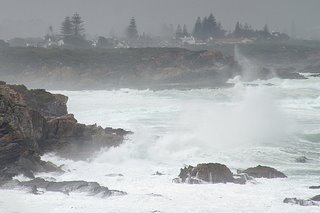 We found a restaurant in Hermanus that was upstairs, with windows on three sides. It was just after the lunch rush, so we were shown to one of the premiere tables, right in the corner with spectacular views in two directions. The rain and wind continued, giving us quite a show to accompany our dinner!
The traffic in and out of Hermanus was horrifying! The main road through the town was choked literally from the eastern entrance to the town all the way through town and out onto the highway. At first we assumed it was simply holiday traffic clogging the roadways, but eventually discovered the cause: two traffic lights at the western end of town were holding up traffic by not allowing enough cars through at each cycle...the lights were programmed for normal Monday traffic, not holiday traffic in which the majority of the cars were all going in one direction. To add insult to injury, at both intersections there were police cars and a gaggle of cops standing around (including Traffic Department cops) looking at the snarl of cars and doing absolutely nothing!
Eventually we got out of town and the traffic moved along nicely until we came to the back up where the holidayers from various destinations all were trying to get onto the same road back to Cape Town at the same time:
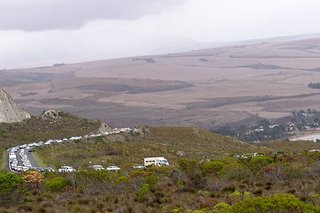 The traffic behind us
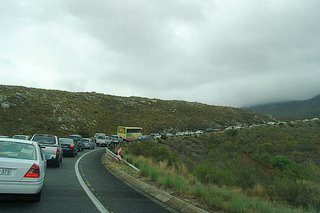 The traffic ahead of us...
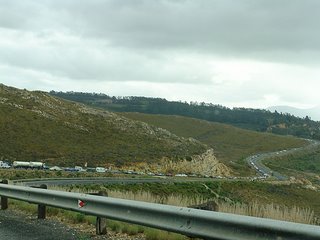 More of the traffic ahead of us
The scary part about all of this traffic is that it was way out in the middle of nowhere and we had no way to gauge how far the jam stretched! But people were, for the most part, polite and good natured and despite all the congestion, we managed to make it home in one piece before the sun went down.
All things considered, it was a nice holiday and I definitely recommend the guesthouses we stayed at: WedgeView in Stellenbosch and Rothman Manor in Swellendam. Lovely, lovely places, well-kept, beautifully appointed, stunning grounds, excellent meals and gracious hosts. We'll be visiting both places again!
Thursday, April 20, 2006
A View from the Overberg, Pt.3
Point Agulhas is the southern-most point of land on the Afrikan continent. Much to our surprise, there was a thriving community there, unlike the uninhabited wilderness of Cape Point. 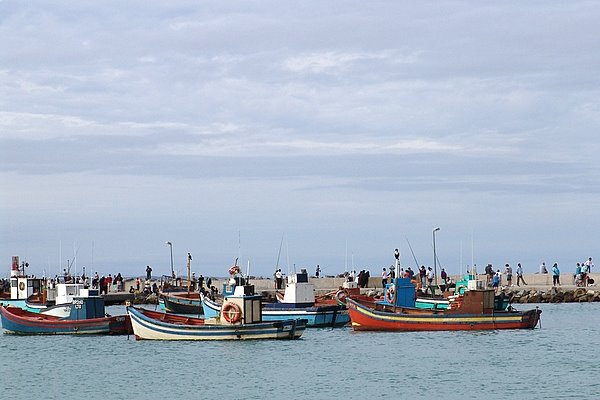 Here is a peek at a part of the fishing fleet.
Cape Town's conceit notwithstanding, the two oceans meet here, at L'Agulhas, not further west along Cape Town's extended environs. You can see the marker but the confluence of the oceans doesn't appear to be particularly roiled up. We saw more exciting surf at Hermanus the following day!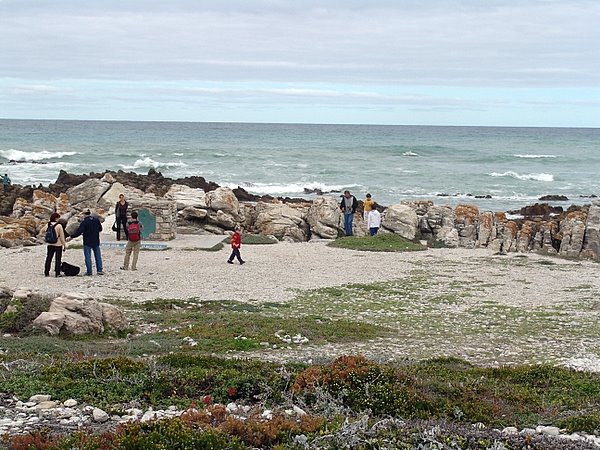
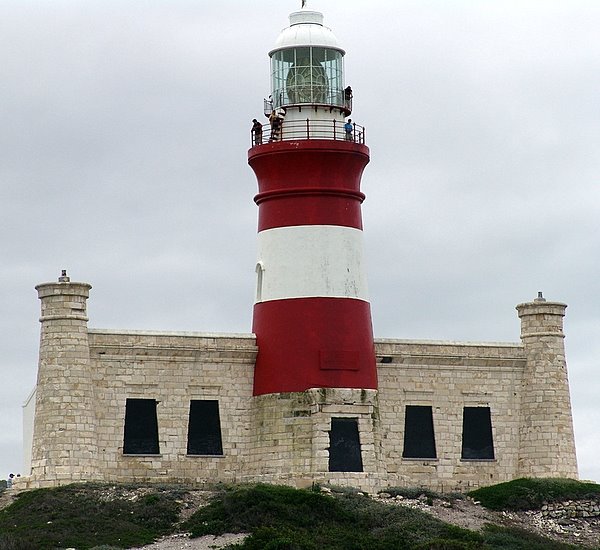
I didn't get any details on the lighthouse, but it's easy to see that this is one very old building! We wondered if those oddly shaped doors might be gunports for old cannon, particularly since the entrance to the lighthouse is on the sheltered side. The old limestone blocks are weathered, but don't appear to have eroded significantly over the centuries. Wonder what those two towers are for?
This flower is the most uncommon-looking thing! There are no leaves, no plant, just this gorgeous translucent bloom thrusting itself upwards from the gravel and rock at the shore. We saw dozens of them, scattered in groups of three or four, their scarlet faces a stark contrast to their barren surroundings.
Next entry: after Hubby spends a dismal night with what he is certain is food poisoning, we awaken to a fresh, light drizzle that doesn't grow into a driving rain until we are on the road. Undeterred...and Hubby's tummy still a bit touchy...we head for Hermanus for lunch and find an upstairs restaurant with stunning views of the storm-tossed coast.
Tuesday, April 18, 2006
A View from the Overberg, Pt 2
So, we left the luxuries of WedgeView (where their premium breakfast is called a "Wedgie") and hit the road for Swellendam. After a couple of hours of ruddy barren fields dotted with the occasional dorpie for a view, a speck of green came onto the horizon, swelling in size with each passing kilometre until we could see the lush green of a town. Swellendam is the third oldest city in South Africa and it is situated along the Breede River, and is immensely fertile. After passing an industrial area, remarkable for the immense grain silos along the roadway, we came into the verdant little town.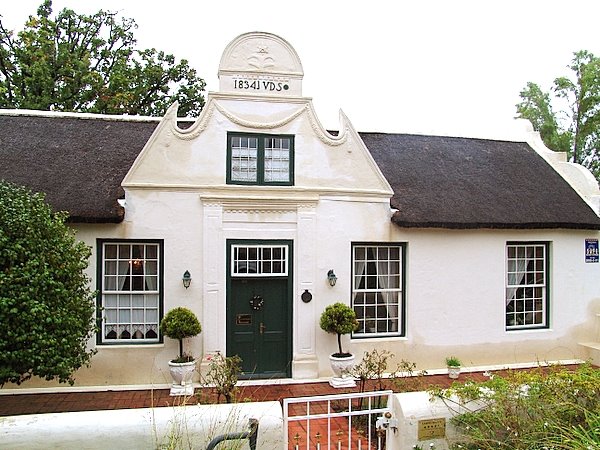
After a right turn onto the main road, Voortrek, the fourth building on the right was our destination: Rothman Manor, a Cape Dutch house built in 1834 and the first in a complex of buildings that makes up this five-star, three-hectare establishment.
The owners, Franziska and Andreas Goebel, are a German couple, a fact reflected in the interior design of the rooms. While the rooms aren't decorated to reflect the historic nature of the property, they are beautifully and luxuriously appointed. We found some unexpected amenities...underfloor heating in the bath (which was tiled with black granite), the guest's cars washed daily, and a well-stocked minibar with fridge snuggled away in the side compartment of what could only be a custom-built desk.
The property includes a huge lily pond, the original dam has been converted into a koi pond (and those koi are HUGE!), a swimming pool and a jacuzzi, and a small private nature reserve that contains deer, zebra, and ostrich (http://www.rothmanmanor.co.za/). A few pics: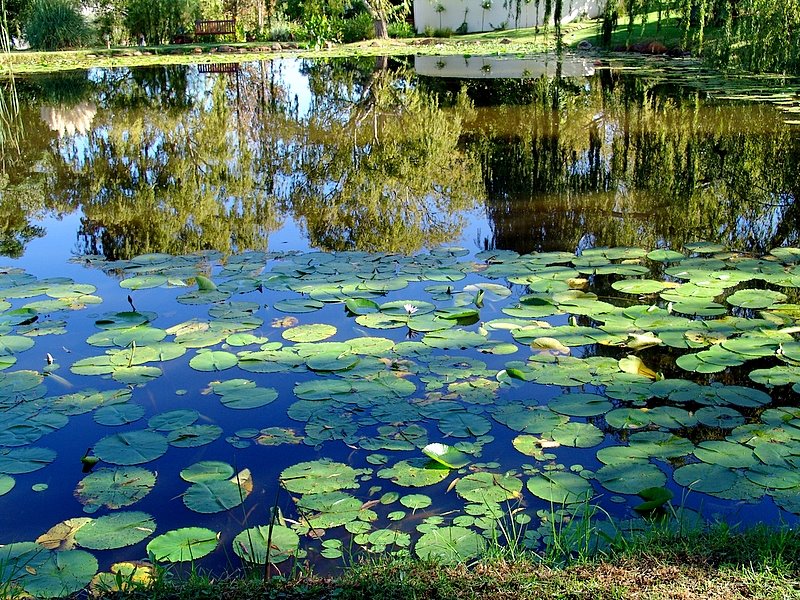 The lily pond
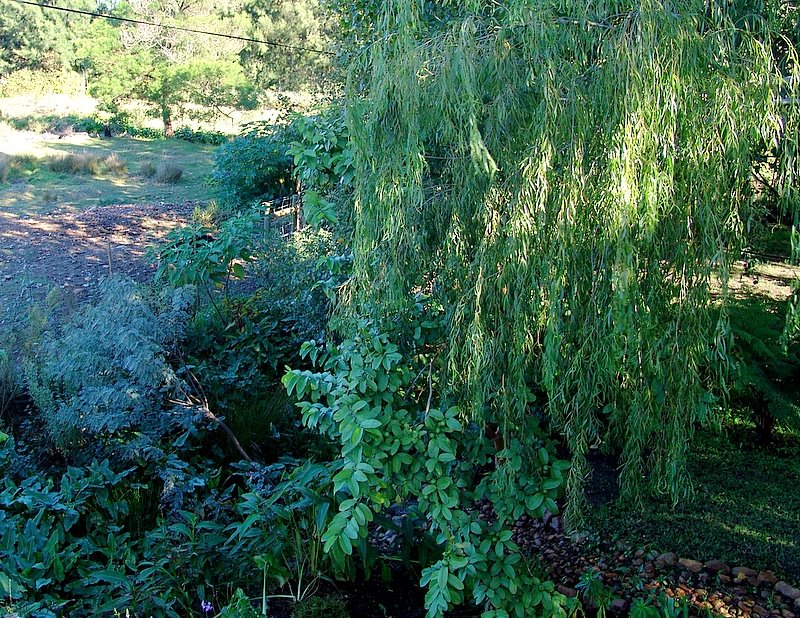 Honest...there is an ostrich in this picture!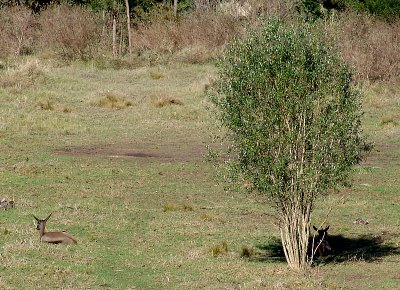
The two little deer are a bit easier to find than the ostrich was.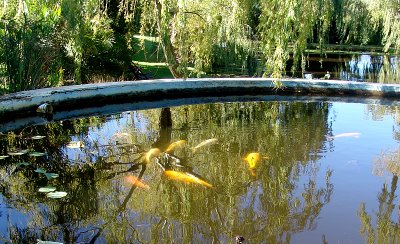
These are the biggest koi I have ever seen!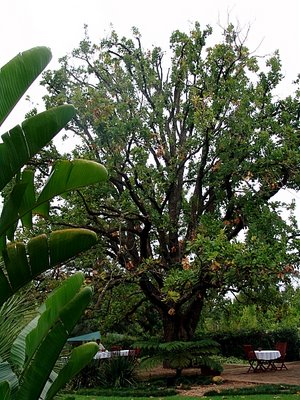
To call the town of Swellendam "quaint" would be a gross understatement. The place is full of buildings two and three hundred years old, most of them in excellent repair and currently occupied. Rothman Manor has an oak tree more than 200 years old under which breakfast is served during appropriate weather.
After a good night's sleep and a hearty breakfast, we set off exploring and ended up at Cape Agulhas, the southern most point of land on the African continent. Next entry: the Indian and Atlantic oceans meet in front of a stunning Old World lighthouse.
Monday, April 17, 2006
A View from the Overberg
Here in South Africa, Easter occasions a four-day weekend and South Africans just love to take to the highways and byways at such times. With the rotor for Koeberg's downed generator safely arrived, Dear Hubby was able to actually take the holiday and Friday we headed out for parts unknown (at least unknown by me).
Our first night on the road was spent in Stellenbosch, only an hour or so away by road, but a world away in amenities. Hubby found a delicious country house...located a couple of kilometres out on a gravel road...and dear old Bertha again did us proud, eating up the bumps and lumps like the trouper that she is. At the end of the dusty journey we found this: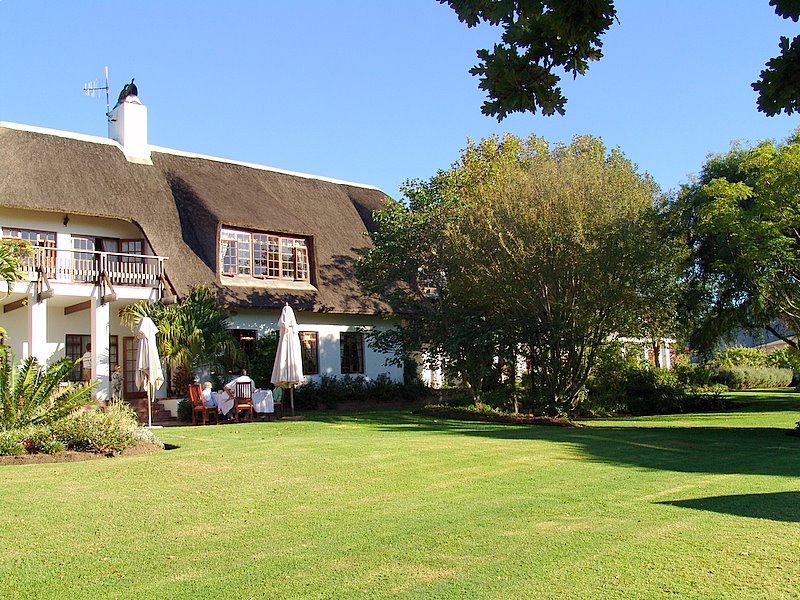 When have you ever seen something this gorgeous? I was stunned! It was the most beautiful place, with 360 degree views of lush vineyards and beautiful mountains. And it had a luxe spa where I sent Hubby off to have his poor tired feet tended with a reflexology session and a pedicure (he's diabetic and must be very good to his feet and he'd been standing on them for days with that rotor arriving in town!).
This is a five-star country house called "WedgeView." The host and hostess, Mike and Trudie Spicer, are British and they immigrated to SA about 9 years ago. Trudie is a true horticulture nut, and the absolutely gorgeous gardens (not to mention the impressive koi pond) are both soothing and stunning at the same time. Here are a few more pics of WedgeView (www.wedgeview.co.za) :
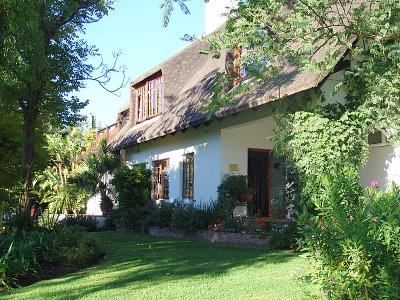
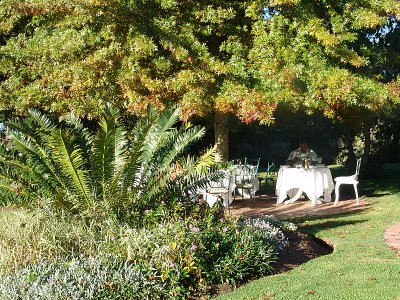 Hubby having breakfast on the terrace (above). Notice the huge cycad to the left.
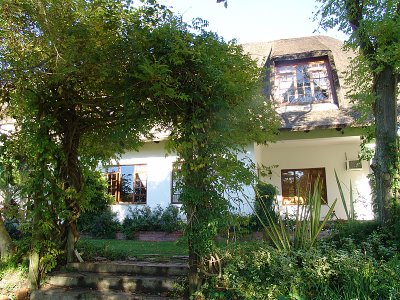
The food was delicious (the quiche was absolutely wonderful!), the service beyond reproach, and the room was spacious, beautifully decorated, and deserved every one of those five stars. We were so impressed, in fact, we plan to return to WedgeView when we have the time to stay more than one night and really make a retreat of the place!
In the morning, after a solid night's sleep, we packed Bertha back up and headed off for our ultimate destination: historic Swellendam and the historic manor house, Rothman Manor (est. 1834), set on 3 hectares of stunning land right on Swellendam's main road! More pics tomorrow.
Sunday, January 08, 2006
There were beautiful plants, too...
 So far, I've pretty much focussed on the animal life and our adventures on holiday, but there were beautiful plants everywhere, from formal, well-tended rose gardens to roadside wildflowers to delicately-leafed acacia trees sporting vicious-looking 3-inch long thorns. And the skies! There is nothing to compare with the intensity of the blue of the South African sky, especially when dotted with a flotilla of surreal-looking clouds. The Karoo boasts the most spectacular skies I have ever had the privilege to observe.
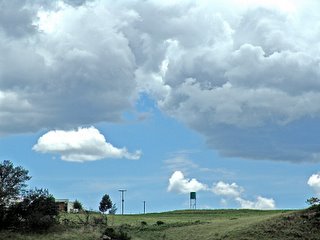 A sudden Midlands thunderstorm, however, brings its own spectacular sky.
 La Provence in Colesberg, where we spent our first night on the road, had some pretty roses in the front garden...
 But Tamakwa Country Lodge in the Midlands (http://www.tamakwa.co.za/) had a lush, lovely rose garden at the entrance.
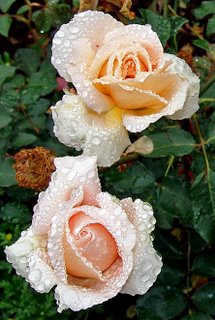 Each Sunday Tamakwa offers a decadent high tea and on an overcast early afternoon we stopped in to sample their offerings...lovely!
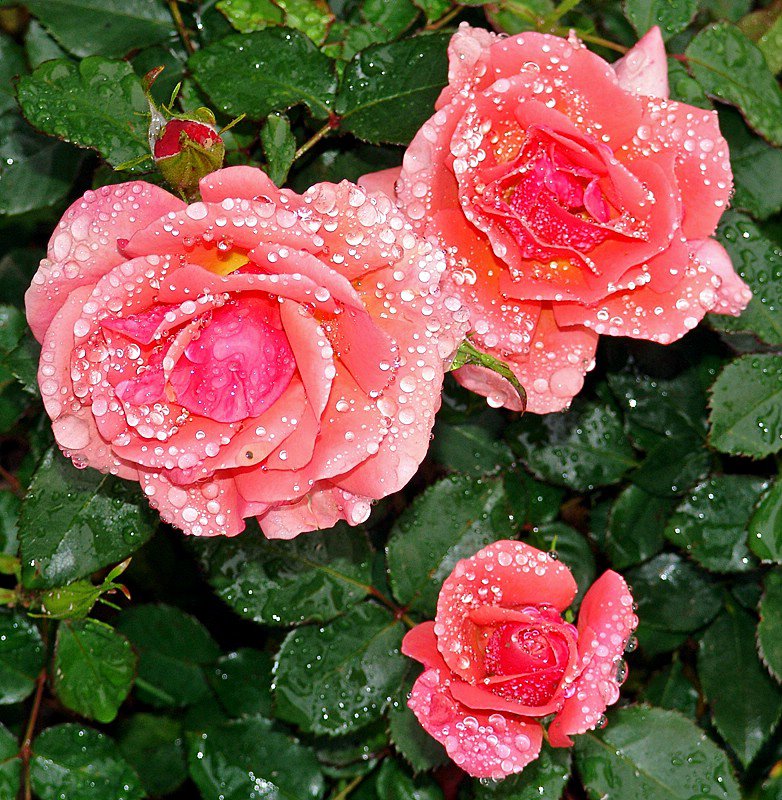 When we stepped back out, after stuffing ourselves with strawberry jam tarts and caramel custard, we found the roses fairly glittering with the results of a gentle rain shower.
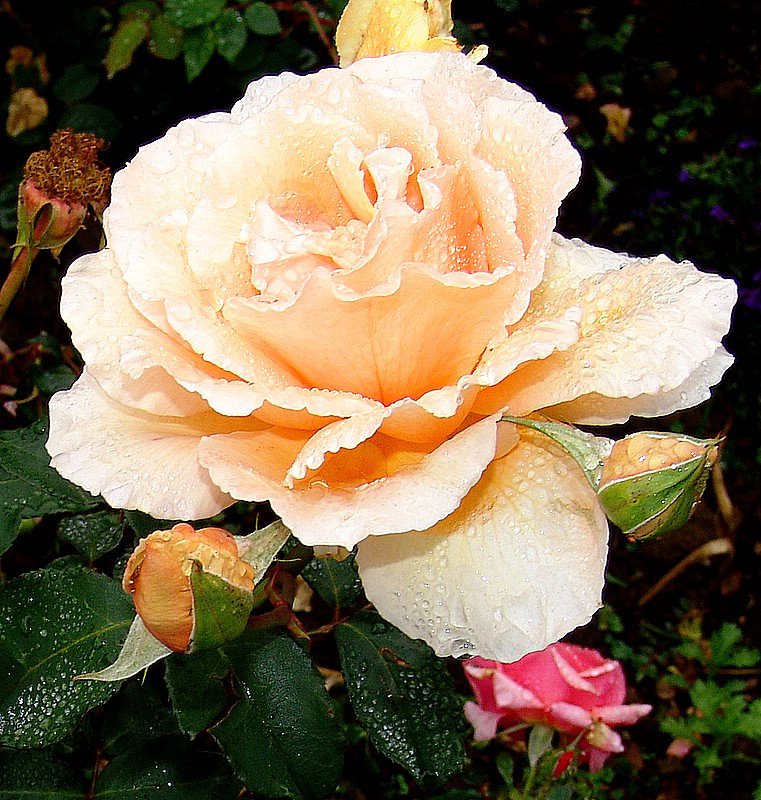 While Hubby got the car, I spent a little time with the camera, taking advantage of this rare opportunity.
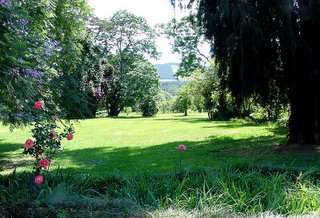 Fern Hill, our hotel in the Midlands, had a beautiful park-like setting. This was the view from the window of our room.
 From the tea garden at Fern Hill we could watch the birds flit through this tranquil water feature.
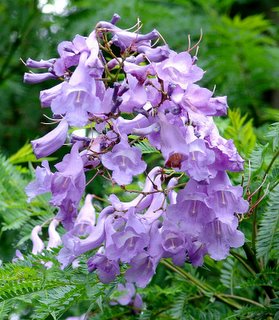 In America we call this a Blue Gum Tree, but in South Africa it is known as a Jacaranda. Fern Hill had an abundance of these delicately-leaved lavender-blossomed beauties.
 These papyrus guard the entrance to the Jacaranda Tea Garden at the Fern Hill Hotel. They are the tallest papyrus...more than 12 feet (4 metres) tall...I have ever seen!
In the Midlands town of Howick, at the end of a narrow walkway bordered by little craft shops, we found this sweet little oasis.

Big Bertha earned her stripes...and a new nickname, "Dirty Bertie,"...on roads like this one. In fact, this was one of the better ones. The greenery in the Midlands was lush and thick at every turn.

Flowers grow wild along the side of the roads, the tar roads as well as the dirt roads. Here is a heap of roses growing on a fence along a main road.

Sunflowers found growing beside a railway bridge abutment
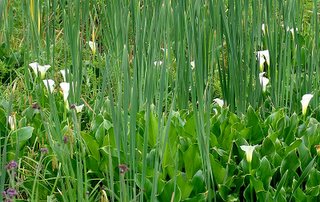
Even calla (arum) lilies grow wild in little swales by the side of the road.

And there is the bouganvillea...
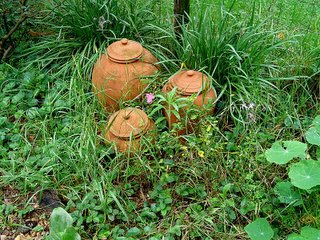
The grounds of the Dargle Valley Pottery were one of the greenest, lushest sites we visited...and it was down one of the darkest, narrowest, most poorly marked roads we encountered!

A field of yellow blooms at the Lion's River Trading Post.

We found a dense copse of blue hydrangea at Mill Cottage in the Midlands.

And an even thicker copse of hydrangea at the Fort Nottingham historical site,...which is way out in the countryside on a really rocky dirt road...outside a quaint little half-timbered building sporting an engraved brass plate identifying it as the consulate of Madagascar!

There are many marshy spots in the Midlands, and dams (ponds, to Americans) are in abundance. Here a little Red Bishop perches on a reed, guarding his nest.

Outside our room in St. Lucia there was this huge tree, a vlamboom (flame tree) thick with blazing red blooms.
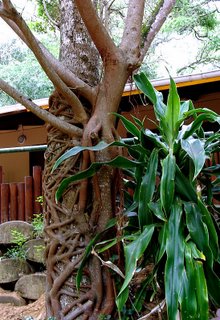
Outside the little convenience store in Cape Vidal we discovered this pair of trees, one wrapped completely around the other via these tendrils. The host tree did not appear to be suffering from its partner's embrace.

I've seen a lot of acacia trees since I've been here...they are very common...but these blooms are the first of this kind I have ever seen.

South Africans are familiar with the thorny acacia trees, but I had never seen one like this until my first visit to South Africa. These thorns are long, vicious and really, really sharp.
Isn't this a stunningly beautiful country?
Subscribe to:
Posts (Atom)


